
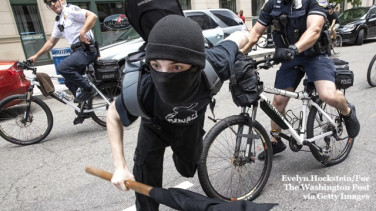
America Reawakens: Combatting the Far-Left Threat
- 07-18-2026America Reawakens: Combatting the Far-Left Threat Leer en Español In a landmark address before representatives from more than 70 countries at the U.S. State Department's Ministerial Conference on...
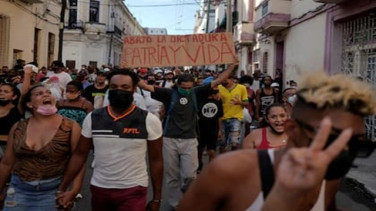
11J at Five: Cuba's Real Unfinished Revolution
- 07-10-202611J at Five: Cuba's Real Unfinished Revolution Photo: REUTERS/Alexandre Meneghini Leer en Español Five years have passed since July 11, 2021 (11J), when thousands of Cubans took to the streets in...
America's 250 th Anniversary: Recovering the Soul of the Republic
- 07-02-2026America's 250 th Anniversary: Recovering the Soul of the Republic Leer en Español The celebration of America's 250th anniversary is more than a commemoration of national independence. It is an...
The Castroist “Reforms”: The Potemkin Façade
- 06-19-2026The Castroist “Reforms”: The Potemkin Façade Leer en Español The Cuban dictatorship’s announcement of 176 economic and social “transformation” proposals should not be mistaken for a historic...
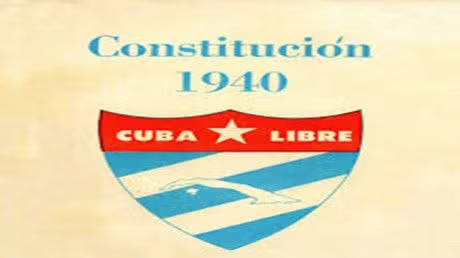
The 1940 Constitution: Cuba’s Democratic Bridge
- 06-12-2026The 1940 Constitution: Cuba’s Democratic Bridge Leer en Español The possibility of a successful democratic transition in Cuba rests upon two historic advantages that distinguish the Cuban case...
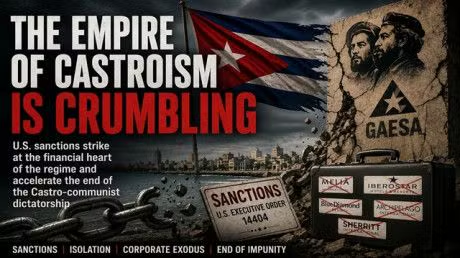
Castroism’s Empire Crumbles
- 06-05-2026Castroism’s Empire Crumbles Leer en Español For decades, opponents of economic pressure against the Castro-Communist regime insisted that sanctions did not work. According to this conventional...
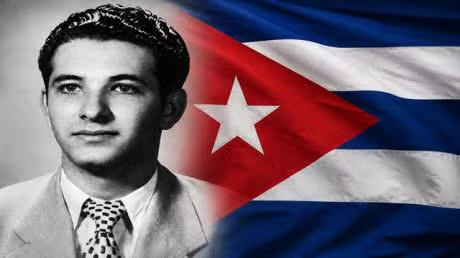
Honoring Pedro Luis Boitel and the Demand for Accountability
- 05-22-2026Honoring Pedro Luis Boitel and the Demand for Accountability Leer en Español This coming Monday, May 25, 2026, marks the 54 th anniversary of the death of Pedro Luis Boitel, a courageous Cuban...
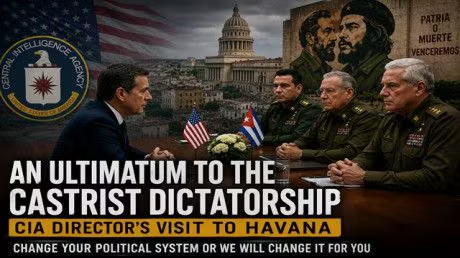
The CIA Director’s Visit to Havana: An Ultimatum in Broad Daylight
- 05-15-2026The CIA Director’s Visit to Havana: An Ultimatum in Broad Daylight Leer en Español The sight is repulsive on its face. A high official of the United States government, the world’s leading...
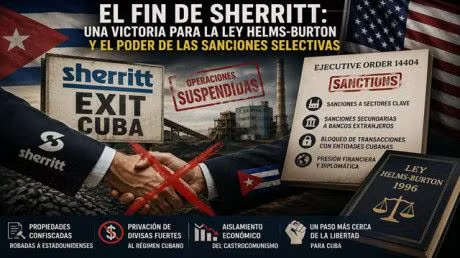
The End of Sherritt: A Victory for Helms-Burton and the Power of Targeted Sanctions
- 05-08-2026The End of Sherritt: A Victory for Helms-Burton and the Power of Targeted Sanctions Leer en Español After more than three decades of open defiance, Sherritt International—the Canadian company...
- Details
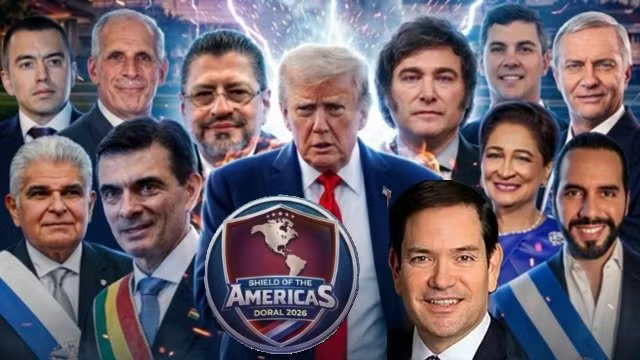 The Shield of the Americas Summit: A Shield in Defense of Freedom
The Shield of the Americas Summit, convened by President Donald J. Trump, will be held this Saturday, March 7, 2026, at the Trump National Doral in Miami. This historic gathering brings together conservative leaders from some 12 Latin American and Caribbean countries to forge a strong coalition against threats that undermine freedom in the hemisphere. Transnational organized crime, narco-terrorism, mass illegal migration, cultural Marxism, continental socialism, and the growing influence of hostile powers such as China, Russia, and Iran are a point of focus.
Confirmed participants—Javier Milei (Argentina), Nayib Bukele (El Salvador), Daniel Noboa (Ecuador), Santiago Peña (Paraguay), along with leaders from Costa Rica, Honduras, Panama, the Dominican Republic, Bolivia, Trinidad and Tobago, and Chile's president-elect, José Antonio Kast—represent the best of the region. These are governments committed to democracy, the market economy, and real security. Recently, Ecuador has already demonstrated results with joint operations against narco-terrorists. El Salvador transformed its reality with a heavy hand against gangs. These leaders do not ask permission to act. The results are products of action, endorsed by the popular sovereignty expressed at the polls.
Read more: The Shield of the Americas Summit: A Shield in Defense of Freedom
- Details
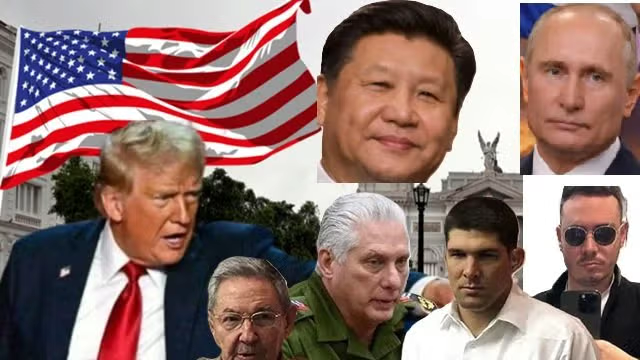 Cuba’s Dictatorial Transition Should Not Fool Anyone
President Donald J. Trump’s January 29, 2026, Executive Order declaring a national emergency over Cuba and authorizing tariffs on any country supplying oil to the regime represents a decisive, long-overdue escalation. Finally, tough rhetoric matches real action, and an apparent policy to dismantle the Castro-Communist stranglehold is taking place. By choking off the island's lifeline of subsidized petroleum—severed from Venezuela after Maduro's ouster, then extended through threats against Mexico and others—the administration is pushing Cuban communism to the brink of collapse. This is not cruelty. It is strategic pressure designed to force genuine change rather than endless "dialogue" that props up tyranny.
The Cuban version of Lenin’s New Economic Policy, the calibrated scheme of comingling foreign investment under dictatorial auspices, began with Fidel Castro with the end of Soviet communism. However, the roots of the current transition gained a foothold under the younger tyrant. Since Raúl Castro assumed power in 2006, Cuba has undergone a calculated dictatorial transition, mirroring post-Soviet Russia's shift from outright centralized socialist dictatorship to kleptocratic totalitarianism. What might have appeared to some as reform has been a calculated façade. Its formulation was designed to preserve elite power, military dominance, and one-party rule under the guise of limited openings. As the United States engages in potential negotiations or conversations (real or imagined) with the Castro-Communist dictatorship, it must remain vigilant against the regime's deceptive evolution. Putinism in the Caribbean must be rejected outright. Only authentic freedom, multiparty democracy, free and fair elections, and the rule of law will suffice.
Read more: Cuba’s Dictatorial Transition Should Not Fool Anyone
- Details
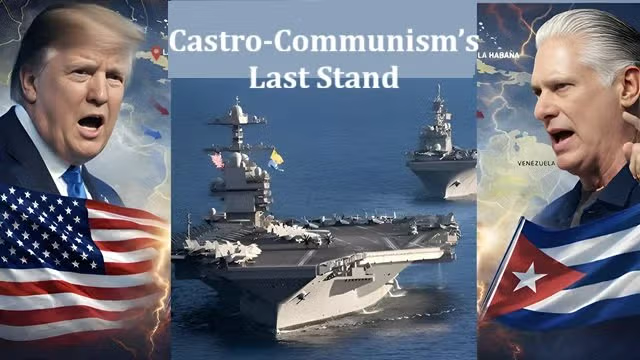 Castro-Communism’s Last Stand
Donald J. Trump has elevated regime change in Cuba to a cornerstone of U.S. regional policy, framing it as essential to national security. Public documents, including a January 29, 2026, Executive Order, declare Cuba's alliances with Russia, China, Iran, and groups like Hamas and Hezbollah as an "unusual and extraordinary threat" to U.S. interests. This order invokes emergency powers to impose tariffs on nations supplying oil to Havana, aiming to starve the regime of resources and force a political transition by year's end.
Trump's rhetoric has been direct and unyielding. Secretary of State and National Security Advisor, Marco Rubio, echoed this during Senate testimony, stating that regime change is a precondition for lifting the embargo under the Helms-Burton Act. Rubio has openly said the administration would "love" to see regime change, hinting at intensified pressure following Maduro's ouster in Venezuela, which severed Cuba's subsidized oil lifeline. Other officials, like Senator Lindsey Graham, predict the dictatorship's fall, arguing economic isolation will cement Trump's legacy.
These statements paint a picture of active negotiations to end 67 years of communist rule, with U.S. officials claiming back-channel talks with Cuban insiders willing to "push out the regime." Yet, top Cuban figures vehemently deny any such dialogue. Cuba’s hand-picked dictator Miguel Díaz-Canel has repeatedly asserted no talks are underway, insisting relations must advance "based on international law rather than hostility, threats, and economic coercion." On February 5, 2026, Díaz-Canel appeared in a pre-recorded and heavily edited “press conference” aired by state media, dressed head-to-toe in black as if in mourning—while blaming the U.S. for an “energy blockade.”
- Details
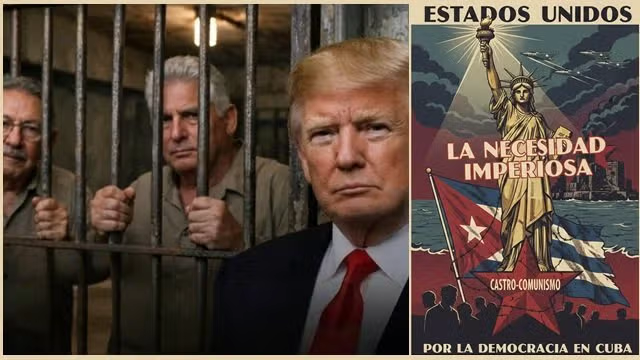 The U.S. Imperative in Toppling Cuba's Communist Regime
The Trump administration's executive orders, national security memorandums, and State Department objectives represent a bold, necessary pivot toward dismantling Cuba's communist dictatorship. This isn't mere posturing—it's a strategic imperative rooted in decades of evidence that half-hearted engagement only prolongs tyranny. Socialism, as the renowned Hungarian economist János Kornai emphatically stated, is irreformable: attempts at “reforming” socialism inevitably falter due to inherent contradictions.
Cuba's chronic crises—rampant poverty, shortages, and repression—are not accidents but deliberate outcomes of a politically induced system plagued by ethical and moral decay. The regime's so-called "reforms" are superficial bandaids, designed to lure foreign investment while preserving iron-fisted control. The more recent MYPIMES (Micro, Small, and Medium Enterprises) projects are kleptocratic attempts to transition Cuba to a Putin-style oligarchic dictatorship. The U.S. must reject these meager concessions outright. Only full-scale regime change can eradicate the root causes and restore prosperity to the Cuban people.
True sovereignty in a democratic framework means popular sovereignty, which Cubans have been denied since Fidel Castro's 1959 ideological coup. At its core, genuine sovereignty in a democratic context means the will of the people, freely expressed. Since the communist seizure of power, Cubans have been stripped of this right, living under a regime that rules through fear and coercion rather than consent. The dictatorship's shrill accusations of U.S. "violations of sovereignty" are cynical fabrications, ignoring that the true sovereigns—the Cuban nation—have been voiceless for generations. Washington should boldly disregard these false claims and act to empower the people, aligning with America's foundational values of liberty and self-determination. To do otherwise is to perpetuate a myth that benefits only the oppressors.
To dismantle this regime, the Trump-era Department of Justice must wield the full force of law. Reactivate the 1993 indictment against Raúl Castro for orchestrating drug trafficking networks that funneled cocaine through Cuba, reaping millions in illicit profits. Equally critical is pursuing charges for the 1996 cold-blooded shootdown of Brothers to the Rescue planes, which murdered three American citizens and a U.S. resident in international airspace—a blatant act of state-sponsored terrorism. Extend these indictments to other regime elites, bolstered by eyewitness testimonies from Colombian narco-traffickers like Carlos Lehder, who detailed personal meetings with Raúl Castro to coordinate smuggling routes. Jhon Jairo Velásquez ("Popeye") further exposed Cuba's deep entanglement in the Medellin Cartel's operations. These aren't allegations—they are corroborated facts that demand accountability, striking at the regime's criminal heart and deterring its enablers.
The Cuban Liberty and Democratic Solidarity (LIBERTAD) Act of 1996 (also known as the Helms-Burton Act) provides a rock-solid legal rationale for regime change, targeting the Cuban Revolution's egregious theft of American property—valued at up to between $6 billion and $8 billion, marking it as the largest such expropriation in history. By fully activating Title III, the U.S. can sue entities profiting from stolen assets, crippling foreign complicity and isolating Havana. This isn't aggression; it's justice, rectifying a historic wrong that funded the regime's survival and underscoring that revolutions built on plunder cannot endure.
For over six decades, Cuban communism has been a breeding ground for Marxist terrorism, housing, training, and arming insurgents from one point of Latin America to the other. Not a single country in the Western Hemisphere has remained unscathed by communist subversion engineered by Castroism. This support endures today, with Havana backing narco-terror groups and subversive elements across the hemisphere. Alarmingly, many radical left-wing organizations in the U.S. serve as covert fronts for Cuban and Chinese influence, peddling propaganda and promoting subversion. Empirical evidence from declassified documents and defector accounts reveals a pattern of exported violence that has claimed thousands of lives, demanding an unyielding U.S. response to neutralize this threat.
Cuba functions as a colossal espionage outpost, posing an existential risk to American security. Trump rightly spotlighted the Lourdes signals intelligence facility—Russia's largest abroad—now augmented by Chinese spy bases and North Korean collaborations, enabling interception of U.S. communications and military secrets. Cuban operatives like Ana Belén Montes and Victor Manuel Rocha, who betrayed U.S. intelligence for decades and provided key disinformation that misled U.S. policy (these are just two examples) and caused irreparable damage. These infiltrations into key U.S. institutions highlight the regime's cunning pragmatism—successful from a dictatorial vantage, even as it fails miserably by democratic standards of popular sovereignty, human rights, and material well-being.
To choke off the regime's lifelines, impose a comprehensive quarantine or outright blockade, severing resource inflows while mitigating civilian suffering through humanitarian aid distributed via impartial channels like the Catholic Church. Immediately halt all remittances—whether cash or goods—along with travel, Obama-Biden-era business licenses, investment schemes, and any mechanisms channeling funds to Havana. These inflows, totaling billions annually, prop up the dictatorship without benefiting ordinary Cubans. Additionally, the DOJ should unleash legal arsenals against GAESA, the military conglomerate dominating Cuba's economy, by targeting its offshore entities in Panama and beyond under RICO-style statutes for racketeering. Prosecute front organizations masquerading as legitimate businesses and hold complicit nations accountable, dismantling the regime's global financial web.
Ultimately, Castro-Communism's totalitarian nature—far more pervasive than mere authoritarianism—demands nothing less than regime change. Its strategic format across the Americas, including insidious influence operations in the U.S., amplifies national security perils: espionage, terrorism sponsorship, and drug empires have cost American lives and undermined stability. Half-measures have failed. Appeasement invites escalation. By pursuing these actions, the U.S. safeguards its interests and champions freedom for 11 million Cubans and the whole of Latin America. Regime change isn't optional—it's the moral and strategic imperative of our time, ensuring a hemisphere free from communist shadows.
© The CubanAmerican Voice. All rights reserved.
 🖋️Author Julio M. Shiling
Julio M. Shiling is a political scientist, writer, columnist, lecturer, media commentator, and director of Patria de Martí and The CubanAmerican Voice. He holds a master’s degree in Political Science from Florida International University (FIU) in Miami, Florida. He is a member of The American Political Science Association, The PEN Club (Cuban Writers in Exile Chapter) and the Academy of Cuban History in Exile.


- Ending the Cuban Communist Dictatorship
- Trump's Triumphant First Year: A Bold Revival
- Cubans Would Welcome U.S. Military Action
- The Capture of Nicolás Maduro: A Turning Point in Confronting Continental Socialism
- The Myth of Progress: Notes on Cuba Before and After Communism
- The Church’s Moment for Reparation