
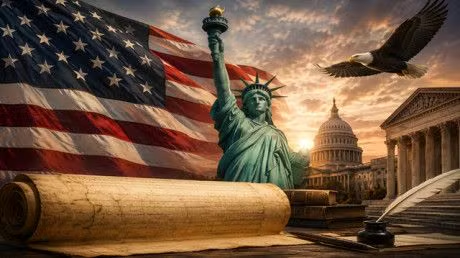
America's 250 th Anniversary: Recovering the Soul of the Republic
- 07-02-2026America's 250 th Anniversary: Recovering the Soul of the Republic Leer en Español The celebration of America's 250th anniversary is more than a commemoration of national independence. It is an...
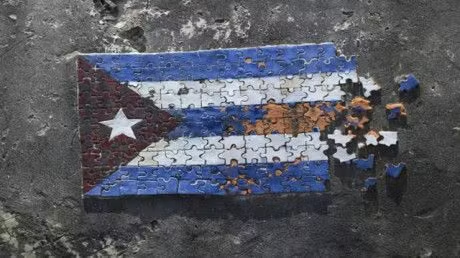
The Castroist “Reforms”: The Potemkin Façade
- 06-19-2026The Castroist “Reforms”: The Potemkin Façade Leer en Español The Cuban dictatorship’s announcement of 176 economic and social “transformation” proposals should not be mistaken for a historic...
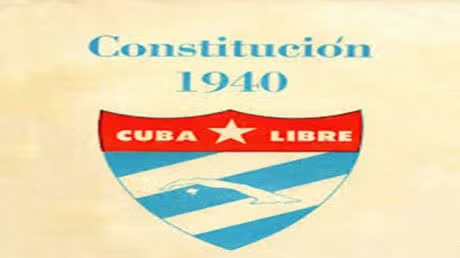
The 1940 Constitution: Cuba’s Democratic Bridge
- 06-12-2026The 1940 Constitution: Cuba’s Democratic Bridge Leer en Español The possibility of a successful democratic transition in Cuba rests upon two historic advantages that distinguish the Cuban case...
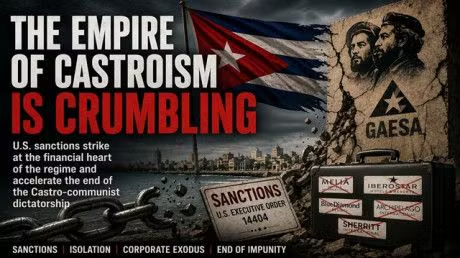
Castroism’s Empire Crumbles
- 06-05-2026Castroism’s Empire Crumbles Leer en Español For decades, opponents of economic pressure against the Castro-Communist regime insisted that sanctions did not work. According to this conventional...
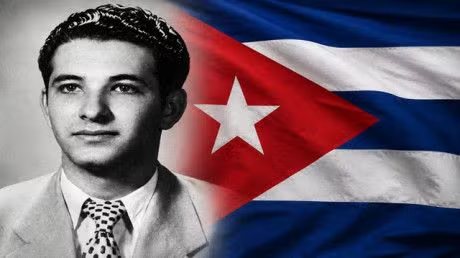
Honoring Pedro Luis Boitel and the Demand for Accountability
- 05-22-2026Honoring Pedro Luis Boitel and the Demand for Accountability Leer en Español This coming Monday, May 25, 2026, marks the 54 th anniversary of the death of Pedro Luis Boitel, a courageous Cuban...
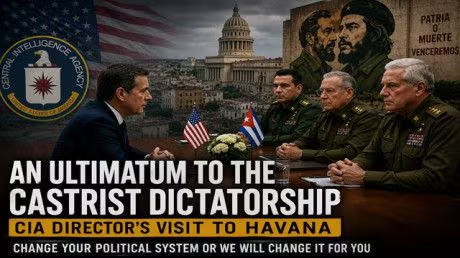
The CIA Director’s Visit to Havana: An Ultimatum in Broad Daylight
- 05-15-2026The CIA Director’s Visit to Havana: An Ultimatum in Broad Daylight Leer en Español The sight is repulsive on its face. A high official of the United States government, the world’s leading...
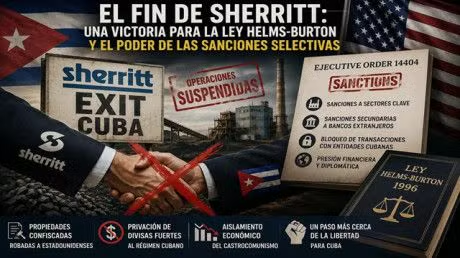
The End of Sherritt: A Victory for Helms-Burton and the Power of Targeted Sanctions
- 05-08-2026The End of Sherritt: A Victory for Helms-Burton and the Power of Targeted Sanctions Leer en Español After more than three decades of open defiance, Sherritt International—the Canadian company...
A Tale of Two Cities: Havana and Washington on May Day
- 05-01-2026A Tale of Two Cities: Havana and Washington on May Day Leer en Español May 1, 2026, exposed two radically opposing political realities unfolding ninety miles apart. In Havana, the Cuban communist...
Crush Castroism Now to Finish Islamic Iran
- 04-17-2026Crush Castroism Now to Finish Islamic Iran Leer en Español The Islamic Republic of Iran is reeling. Its senior leadership has been decapitated, its missile factories and air defenses lie in ruins,...
- Details
 America's 250 th Anniversary: Recovering the Soul of the Republic
The celebration of America's 250th anniversary is more than a commemoration of national independence. It is an invitation to reconsider the moral architecture upon which the American Republic was constructed. To ask whether the philosophical inheritance that sustained the nation for two and a half centuries remains sufficiently intact to preserve it for generations yet unborn. Every civilization ultimately lives not by economics or military power alone, but by the ideas it believes, the virtues it cultivates, and the transcendent truths it acknowledges.
The United States was unique among nations because it was founded upon propositions rather than ethnicity, dynasty, or conquest. The Declaration of Independence proclaimed that human rights do not originate in government but are endowed by the Creator. Government exists, the text argued, not to bestow liberty but to secure liberties that already belong to the human person by nature as an act of God. The Constitution translated those principles into institutions, creating a political order designed not merely to govern but to restrain government itself.
Read more: America's 250 th Anniversary: Recovering the Soul of the Republic
- Details
 The Castroist “Reforms”: The Potemkin Façade
The Cuban dictatorship’s announcement of 176 economic and social “transformation” proposals should not be mistaken for a historic opening or a genuine abandonment of the failed system that has governed the island for more than six decades. Behind the language of modernization, private enterprise, market mechanisms, and economic renewal lies a carefully calculated strategy of political survival. The Castro-Communist leadership is attempting to construct a Potemkin façade: the appearance of change without the substance of transformation.
The regime understands that the economic model it invented in the 1990s is collapsing. Cuba is facing a profound national crisis marked by prolonged blackouts, inflation, shortages, declining production, financial instability, institutional decay, and an increasing wave of public protests and social unrest. Yet rather than acknowledge that these failures are the inevitable consequences of totalitarian rule and centralized control, Havana has chosen a different narrative: Cuba’s problem, it claims, is primarily economic.
- Details
 The 1940 Constitution: Cuba’s Democratic Bridge
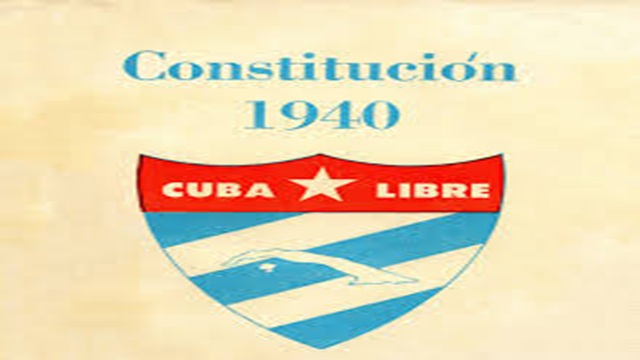
The possibility of a successful democratic transition in Cuba rests upon two historic advantages that distinguish the Cuban case from many other societies emerging from totalitarian rule. These advantages are interconnected and mutually reinforcing. Cuba possesses a republican tradition upon which democratic reconstruction can be built, and the Cuban nation that survived in exile preserved the cultural identity, historical memory, and civic traditions that the Castro-Communist regime attempted to erase. Together, these two realities provide the foundation for a constitutional renewal rooted not in political invention but in historical restoration.
The first advantage is Cuba’s own republican experience before 1959. Contrary to the historical narrative promoted by the Castro regime, Cuba was not a society without democratic foundations waiting to be liberated by revolutionary rule. Between independence in 1902 and the destruction of the constitutional order in 1959 (first derailed in 1952), Cuba experienced a functioning—although imperfect—republic. There were political parties representing different ideological currents, competitive elections, peaceful transfers of power, an active civil society, independent institutions, and a political culture shaped by constitutionalism. Cuba experienced periods of authoritarian interruption, particularly during military regimes, but these episodes did not destroy the foundations of republican life. Civil society remained vibrant, political pluralism survived, and the essential idea of Cuba as a constitutional republic endured.
- Details
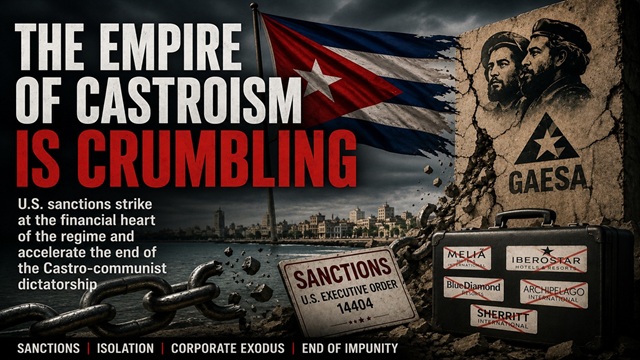 Castroism’s Empire Crumbles
For decades, opponents of economic pressure against the Castro-Communist regime insisted that sanctions did not work. According to this conventional wisdom, Havana had learned to survive every restriction, adapt to every obstacle, and transform every hardship into political propaganda. Yet the dramatic developments following President Donald Trump's Executive Order 14404 have exposed the weakness of that argument. The events of the past month demonstrate that sanctions not only work, but that they work most effectively when they are designed around a clear understanding of the regime's actual structure and sources of power.
Signed on May 1, 2026, Executive Order 14404 represents the most serious challenge ever directed against the financial architecture that has sustained Castro-Communism since the collapse of the Soviet Union. Rather than focusing exclusively on individual officials or symbolic restrictions, the order targets the extensive network of foreign corporations, investors, banks, shipping companies, hotel operators, and commercial partners. These have enabled the regime to survive long after the disappearance of Soviet subsidies.
- Honoring Pedro Luis Boitel and the Demand for Accountability
- The CIA Director’s Visit to Havana: An Ultimatum in Broad Daylight
- The End of Sherritt: A Victory for Helms-Burton and the Power of Targeted Sanctions
- A Tale of Two Cities: Havana and Washington on May Day
- Crush Castroism Now to Finish Islamic Iran
- Cuba’s Spy State Next Door: Time to End the Castro Regime