
 The Capture of Nicolás Maduro: A Turning Point in Confronting Continental Socialism
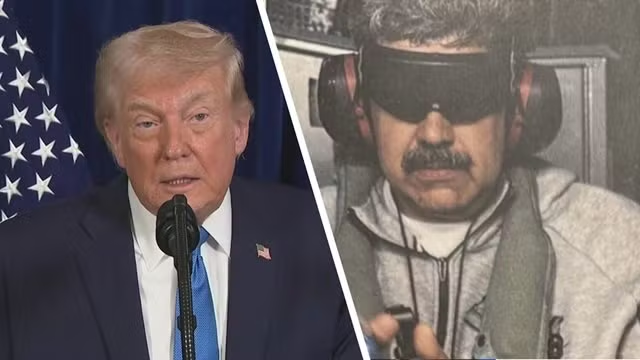
In the early hours of January 3, 2026, the world awoke to stunning news: Venezuelan dictator Nicolás Maduro and his wife, Cilia Flores, had been captured in a daring U.S.-led operation. While the specifics of the raid—rumored to involve elite special forces, cyber disruptions, and local intelligence assets—remain shrouded in secrecy, the implications are profound. This bold action signals a seismic shift in U.S. foreign policy: a new paradigm aimed at directly confronting the scourge of continental socialism across Latin America. For too long, this ideological cancer has been financially underwritten by the illicit drug trade, allowing it to fester and spread. The Maduro regime's downfall, should it play out, would not merely be the ousting of a tyrant. It would be a deliberate strike against a network that has poisoned the hemisphere, subsidized by narcotics profits and bolstered by foreign adversaries.
The roots of this crisis trace back to decades of U.S. disengagement from Latin America. Following the Cold War's end, American attention pivoted to the Middle East, Europe, and Asia, leaving a vacuum in its own backyard. Into this void poured opportunistic powers: China, with its Belt and Road investments and resource grabs; Russia, arming regimes and meddling in elections; Iran, exporting its revolutionary zeal through proxy militias; and North Korea, acting as a Chinese surrogate in arms deals and nuclear technology transfers. These nations exploited the region's instability, propping up leftist governments that promised equality but delivered poverty and repression. Venezuela, under Maduro, became a prime example—a failed state where hyperinflation, food shortages, and human rights abuses were normalized under the guise of "Bolivarian socialism."
This socialism is no relic of the past but a mutated form of communism, evolving from the Soviet Union's collapse in 1991. The São Paulo Forum, founded in 1990 by Fidel Castro and Luiz Inácio Lula da Silva, epitomized this adaptation. It provided a blueprint for dictatorial rule masquerading as “democratic” socialism, linking leftist movements from Argentina to Nicaragua. At its core stood communist Cuba, the new imperialist hub, wielding influence far beyond its island borders. Havana's regime, starved of Soviet subsidies, reinvented itself as the ideological vanguard, exporting doctors, spies, and revolutionaries in exchange for resources. Venezuela's vast oil reserves became Cuba's lifeline, with Maduro shipping millions of barrels at subsidized prices—estimated at over $30 billion since 2000. This petro-diplomacy was augmented by darker revenues: the drug business, where Venezuelan officials, including Maduro's inner circle, allegedly facilitated cocaine trafficking through the "Cartel of the Suns." Neo-slave labor, in the form of forced work in mines and farms, further padded the coffers, turning human misery into ideological fuel.
The U.S. operation against Maduro marks a rejection of this status quo. By targeting the Venezuelan strongman, Washington is signaling an intent to dismantle the broader ecosystem of continental socialism. Maduro's regime was not just a domestic failure but a Cuban-controlled colony, with Havana's intelligence apparatus embedded in Caracas' security forces. Venezuelan military and political decisions often required Cuban approval, transforming the oil-rich nation into a satellite state. This model extends across the region both, in regimes and governments like in Nicaragua, Brazil, Colombia, and Mexico. Alarmingly, these ties reach northward. Marxist domestic terrorist groups in the U.S., echo the rhetoric of the São Paulo Forum, advocating for "anti-imperialist" struggles that align with Havana's worldview. The drug trade, funneling billions from Latin American cartels to U.S. streets, serves as a financial bridge, laundering money that indirectly supports these networks.
Yet, questions linger about the operation's ultimate efficacy. The details of how U.S. forces successfully evaded Venezuelan and Cuban defenses, points to enormous vulnerabilities within Castro-Communism’s intelligence apparatus. More critically, does this capture pave the way for eradicating Marxist-Leninist influence from Latin America? The path ahead is uncertain. Interim Venezuelan leadership must navigate elections, economic reconstruction, and purging Cuban infiltrators and Venezuelan accomplices. Broader U.S. strategy will require sustained engagement: economic incentives to counter Chinese loans, security partnerships to expel Russian arms, and diplomatic pressure on Iranian and North Korean envoys. Failure to follow through risks a power vacuum, inviting further chaos.
This action, nevertheless, is unequivocally welcome news. It disrupts the flow of drug money and oil subsidies that have sustained Cuba's dictatorship and imperialist format for decades. By confronting socialism head-on, the U.S. reasserts its role as a hemispheric leader, prioritizing Latin America after years of neglect. This is not interventionism for its own sake but a necessary antidote to a "disease" that has claimed millions of lives through famine, exile, and repression. As socialist movements—in power or opposition—reveal their unbreakable links to Castro-Communism, America must recognize the interconnected threat. From Venezuelan streets to U.S. campuses, the ideology persists, demanding vigilance. 2026 is off to a fine start. With Maduro in custody, perhaps the dawn of a post-socialist era in Latin America is within reach. The U.S. has fired the opening salvo; now, it must commit to the fight.
© The CubanAmerican Voice. All rights reserved.
 🖋️Author Julio M. Shiling
Julio M. Shiling is a political scientist, writer, columnist, lecturer, media commentator, and director of Patria de Martí and The CubanAmerican Voice. He holds a master’s degree in Political Science from Florida International University (FIU) in Miami, Florida. He is a member of The American Political Science Association, The PEN Club (Cuban Writers in Exile Chapter) and the Academy of Cuban History in Exile.

