
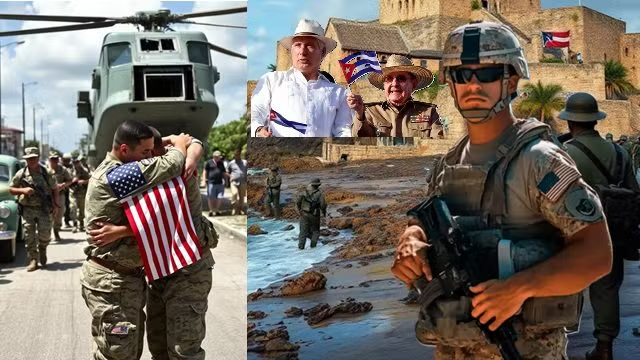
 Cubans Would Welcome U.S. Military Action
For more than six decades, U.S. policy toward Cuba has generally oscillated between containment, engagement, sanctions, and rhetorical support for democratic aspirations. What has remained largely unchanged is the assumption—shared by many well-intentioned observers—that peaceful civic resistance, international pressure, and gradual liberalization could ultimately bring about regime change. History has shown otherwise. In totalitarian systems, particularly Marxist–Leninist regimes modeled on Cuban state doctrine, non-violent strategies alone do not dismantle power. They merely coexist with it.
The Trump administration’s renewed emphasis on reversing communist gains in Latin America reflects a strategic recalibration long overdue. The naval presence in the Gulf of Mexico and Caribbean, combined with decisive action against socialist strongholds in Venezuela and potentially elsewhere in the hemisphere, signals a recognition of a fundamental reality. Force, when legitimate and intelligently applied, remains the only proven mechanism for overthrowing entrenched totalitarian regimes.
Pacifist regime-change strategies have succeeded primarily in democratic or semi-democratic systems. These are states where power holders are constrained by law, public opinion, or institutional accountability. Non-violent movements can compel concessions in such environments because governments fear electoral loss, reputational damage, or judicial consequences. Totalitarian regimes fear none of these. They are afraid only of the loss of coercive control.
Cuba is not an authoritarian system in transition; it is a mature totalitarian state. Its intelligence services, internal security forces, military hierarchy, and political institutions are unified under a single party whose legitimacy rests not on consent but on ideological permanence and repression. The regime survived the collapse of the Soviet Union, decades of economic isolation, mass emigration, and recurring social unrest precisely because it is structurally immune to civic pressure. The use of alternate schemes for financing its operations upon the fall of the USSR, such as Venezuelan oil, drug-trafficking income, neo-slave labor leasing, and intelligence information trafficking, has shown that Castro-Communism can be resourceful when it comes to pillaging for survival's sake.
This is why nonviolent resistance in Cuba, while morally admirable and politically necessary, has never produced regime collapse. Protest movements—from dissident intellectuals to the island-wide demonstrations of July 2021—have exposed the regime’s fragility and brutality, but they have not dislodged it. Instead, they have been met with arrests, exile, amplified surveillance, and expanded repression. In totalitarian contexts, grievance campaigns do not force concessions. They merely test repression thresholds.
That does not render nonviolent action useless. On the contrary, it plays a critical preparatory role. Civic resistance delegitimizes the regime, fractures elite consensus, weakens ideological cohesion, and signals popular willingness for change. But these effects only become decisive when paired with a coercive catalyst—either internal military defection or external force. No communist dictatorship has fallen solely because citizens protested peacefully.
Historical precedent confirms this. From Eastern Europe to Central America, totalitarian systems collapse when force—explicit or implicit—enters the equation. The Reagan Doctrine aggressively challenged Soviet communism. Military action against global Marxism was fought hard and with determination. The fall of the Berlin Wall was no accident. U.S. military interventions in Grenada and Panama dismantled Marxist and kleptocratic regimes that diplomacy could not. In each case, civic resistance mattered—but it was not the ultimate deciding factor.
Cuba today presents conditions uniquely favorable to a limited, intelligence-driven U.S. operation. The regime faces severe economic exhaustion, demographic decline, energy shortages, and waning ideological loyalty among younger generations. Its international patrons are stretched, distracted, or unreliable. Unlike during the Cold War, Havana no longer enjoys a superpower security guarantee. What remains is a brittle, coercive apparatus holding together a collapsing state.
Crucially, modern military operations need not resemble Cold War invasions or prolonged occupations. Advances in intelligence gathering, cyber capabilities, precision force, and information warfare allow for targeted interventions aimed at decapitating regime leadership, neutralizing security command structures, and enabling a rapid internal transition. The objective is not occupation but disruption, creating a power vacuum that domestic democratic forces, previously suppressed, can fill. In other words, the stage is set for Cuba’s liberation.
With U.S. naval assets already positioned in the Gulf, a precision incursion—targeting key leaders like Miguel Díaz-Canel—would exploit internal fractures. Cubans, both inside and outside the island, long yearning for freedom, would welcome liberators. Intelligence reveals regime vulnerabilities: economic collapse, youth disillusionment, and military defections. Technology ensures low-risk execution—cyber hacks to paralyze defenses, special ops to secure Havana. Cuba is the real measure of the success of the Trump Doctrine.
Opponents of such action argue that military intervention risks instability or backlash. Yet instability already defines Cuba’s trajectory. Managed disruption, followed by an internationally supported transition framework, is less dangerous than indefinite stagnation under a collapsing totalitarian state. Moreover, there is substantial evidence that a decisive intervention would be welcomed by large segments of the Cuban population, including elements within the military whose loyalty is transactional rather than ideological.
A U.S. operation against the Cuban communist regime would not be an act of imperialism but a strategic intervention aligned with hemispheric stability and democratic norms. It would signal that totalitarian entrenchment in the Americas is no longer tolerated, and that regimes sustained by repression, not consent, cannot rely indefinitely on diplomatic paralysis. The successful arrest of communist Cuba’s puppet dictator, Nicolas Maduro, and the apparent takeover of the Chavista regime affirm the viability of affirmative U.S. action.
The lesson is clear: pacifism alone does not overthrow communism. It prepares the ground, exposes injustice, and mobilizes conscience. However, the final breach of totalitarian power requires force. If the United States is serious about reversing socialist rule in the Western Hemisphere, neutralizing a key ally of American domestic terrorism, and promoting peace in the region, Castro-Communism must go. Cuba must not be the exception and remain untouched by this bold U.S. foreign and moral policy initiative. Cuba is the paradigmatic test case.
© The CubanAmerican Voice. All rights reserved.
 🖋️Author Julio M. Shiling
Julio M. Shiling is a political scientist, writer, columnist, lecturer, media commentator, and director of Patria de Martí and The CubanAmerican Voice. He holds a master’s degree in Political Science from Florida International University (FIU) in Miami, Florida. He is a member of The American Political Science Association, The PEN Club (Cuban Writers in Exile Chapter) and the Academy of Cuban History in Exile.

