
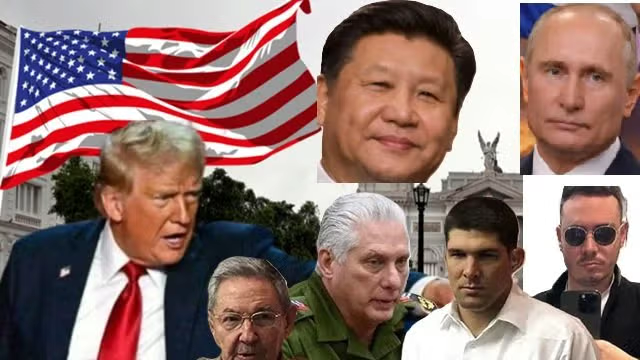
 Cuba’s Dictatorial Transition Should Not Fool Anyone
President Donald J. Trump’s January 29, 2026, Executive Order declaring a national emergency over Cuba and authorizing tariffs on any country supplying oil to the regime represents a decisive, long-overdue escalation. Finally, tough rhetoric matches real action, and an apparent policy to dismantle the Castro-Communist stranglehold is taking place. By choking off the island's lifeline of subsidized petroleum—severed from Venezuela after Maduro's ouster, then extended through threats against Mexico and others—the administration is pushing Cuban communism to the brink of collapse. This is not cruelty. It is strategic pressure designed to force genuine change rather than endless "dialogue" that props up tyranny.
The Cuban version of Lenin’s New Economic Policy, the calibrated scheme of comingling foreign investment under dictatorial auspices, began with Fidel Castro with the end of Soviet communism. However, the roots of the current transition gained a foothold under the younger tyrant. Since Raúl Castro assumed power in 2006, Cuba has undergone a calculated dictatorial transition, mirroring post-Soviet Russia's shift from outright centralized socialist dictatorship to kleptocratic totalitarianism. What might have appeared to some as reform has been a calculated façade. Its formulation was designed to preserve elite power, military dominance, and one-party rule under the guise of limited openings. As the United States engages in potential negotiations or conversations (real or imagined) with the Castro-Communist dictatorship, it must remain vigilant against the regime's deceptive evolution. Putinism in the Caribbean must be rejected outright. Only authentic freedom, multiparty democracy, free and fair elections, and the rule of law will suffice.
Raúl Castro's era introduced "raulismo"—a calculated survival playbook that preserved Leninist one-party control while draping despotism in selective "private" elements. Far from liberalization, these changes were engineered to enrich the elite, entrench military dominance, and buy time amid economic ruin. The military's GAESA conglomerate stands as Exhibit A: this opaque behemoth controls vast swaths of tourism, retail, remittances, imports, and more—estimated at 70% or higher of the economy—generating billions while ordinary Cubans face blackouts, empty shelves, and despair. Recent revelations show GAESA hoarding $18 billion in reserves even as the regime cries poverty and starves its people of medicine. This is classic kleptocracy: state capitalism where the armed forces and high party officials siphon wealth through concessionary deals, all shielded from accountability.
The 2011 "Lineamientos" (Economic and Social Policy Guidelines) promised efficiency, self-employment expansion, and foreign investment to achieve ambitious growth. In reality, they operated strictly within the Communist Party's iron framework, delivering anemic results—averaging far below targets—while bureaucratic dogmatism killed true entrepreneurship. The 2019 constitution codified this hybrid trap. The Cuban dictatorship’s latest magna carta declared socialism "irrevocable," reaffirmed the Party's unchallenged leadership, and offered token nods like recognizing private property and term limits—yet dismantled nothing fundamental. It mirrors Russia's post-Soviet makeover: authoritarian continuity masked as modernization.
Enter Miguel Díaz-Canel, the non-Castro puppet "president" since 2018—a handpicked loyalist who changed nothing substantive. Under his watch, the regime rolled out MYPYMEs (micro, small, and medium enterprises) in 2021, now numbering over 11,000 and employing hundreds of thousands. Recent tweaks in 2024-2025 tightened controls: stricter partner rules, more forbidden activities, local approvals, and continued state monopolies on key inputs. Private ventures must import through regime gatekeepers, align with "socialist principles," and face sudden reversals. These are not free markets—they are concessionary capitalism, where apparent openings enrich cronies and political elites while the Party retains veto power. Even 2025 foreign investment "reforms"—monetary flexibility, faster approvals—stay locked within the 2019 constitution's red lines, ensuring no threat to centralized tyranny.
This Russian-style evolution—from dogmatic communism to oligarchic kleptocracy—poses a grave danger. Like Putin's Russia, Cuba's rulers seek permanence through economic illusions, allying with China, Russia, and Iran while crushing dissent. Trump's oil chokehold, building on terrorism sponsor status, visa bans, and Helms-Burton enforcement, rightly targets these vulnerabilities. It echoes the pressure that felled Maduro—proving sanctions work when applied relentlessly.
The Castroist regime will fight back with false promises, performative "reforms" and humanitarian pleas, hoping to lure naive concessions. Any U.S. dialogue must reject this trap outright. No deals that accommodate nondemocratic permanence should be suitable. No acceptance of a rebranded autocracy where elections remain a sham, political prisoners stay jailed, and GAESA's kleptocrats keep their loot. The Cuban people—enduring ghost-town streets, trash piles, humanitarian collapse, and crimes against humanity—expect real liberation. The American people need the assurance that an enemy that has killed their citizens, plundered their wealth, enabled domestic terrorism, and served as a subversive base for foreign enemies must be liquidated. The Castro-Communist era must end, not evolve. Cuba's freedom is within reach—America must not blink now.
© The CubanAmerican Voice. All rights reserved.
 🖋️Author Julio M. Shiling
Julio M. Shiling is a political scientist, writer, columnist, lecturer, media commentator, and director of Patria de Martí and The CubanAmerican Voice. He holds a master’s degree in Political Science from Florida International University (FIU) in Miami, Florida. He is a member of The American Political Science Association, The PEN Club (Cuban Writers in Exile Chapter) and the Academy of Cuban History in Exile.

