
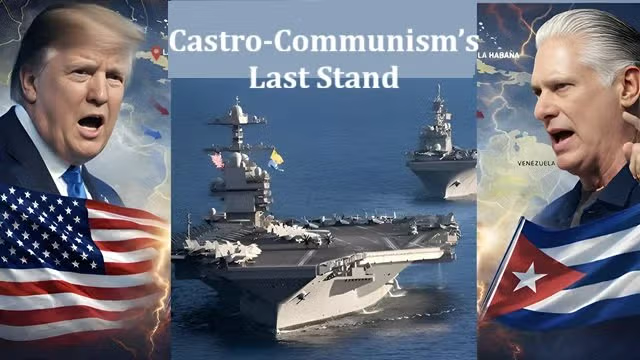
 Castro-Communism’s Last Stand
Donald J. Trump has elevated regime change in Cuba to a cornerstone of U.S. regional policy, framing it as essential to national security. Public documents, including a January 29, 2026, Executive Order, declare Cuba's alliances with Russia, China, Iran, and groups like Hamas and Hezbollah as an "unusual and extraordinary threat" to U.S. interests. This order invokes emergency powers to impose tariffs on nations supplying oil to Havana, aiming to starve the regime of resources and force a political transition by year's end.
Trump's rhetoric has been direct and unyielding. Secretary of State and National Security Advisor, Marco Rubio, echoed this during Senate testimony, stating that regime change is a precondition for lifting the embargo under the Helms-Burton Act. Rubio has openly said the administration would "love" to see regime change, hinting at intensified pressure following Maduro's ouster in Venezuela, which severed Cuba's subsidized oil lifeline. Other officials, like Senator Lindsey Graham, predict the dictatorship's fall, arguing economic isolation will cement Trump's legacy.
These statements paint a picture of active negotiations to end 67 years of communist rule, with U.S. officials claiming back-channel talks with Cuban insiders willing to "push out the regime." Yet, top Cuban figures vehemently deny any such dialogue. Cuba’s hand-picked dictator Miguel Díaz-Canel has repeatedly asserted no talks are underway, insisting relations must advance "based on international law rather than hostility, threats, and economic coercion." On February 5, 2026, Díaz-Canel appeared in a pre-recorded and heavily edited “press conference” aired by state media, dressed head-to-toe in black as if in mourning—while blaming the U.S. for an “energy blockade.”
The absurdly theatrical getup, paired with the visible afternoon clock on moderator Arleen Rodríguez Derivet’s wrist proving it wasn’t live, turned the event into a widely mocked propaganda stunt rather than any serious exchange. Deputy Foreign Minister Carlos Fernández de Cossío was not too distant away as far as futile attempts to mask the truth goes. The communist master spy acknowledged "communications" but clarified they fall short of formal negotiations, rejecting any discussion of internal political changes. Prime Minister Manuel Marrero has similarly dismissed U.S. overtures, warning of "difficult times ahead" but vowing resilience.
Cuban communist leaders are doubling down on defiance, ignoring Trump's warnings. Díaz-Canel labeled the oil tariffs "fascist, criminal, and genocidal," accusing the U.S. of suffocating the economy for personal gain. Cossío and Marrero have echoed this, framing U.S. actions as interference while affirming Cuba's “sovereignty,” something absurd considering Cuban communism’s submission to foreign powers, alliances, and geopolitical state planning. In speeches, Díaz-Canel invoked "patria o muerte" (homeland or death), signaling no surrender. This bravado masks desperation, as officials prepare for a "special period" reminiscent of the post-Soviet collapse in the 1990s.
Plans include prioritizing state fuel use, slashing energy expenditure, and redistributing scarce resources. Provinces are instructed to achieve self-sufficiency through local production—a notion that borders on delusional given Cuba's centralized economy and lack of resources. Each region supporting itself with its outputs? That's not strategy; it's insanity, ignoring basic economics and the island's import dependency. Food, medicine, and fuel shortages are already rampant, with daily blackouts extending to 20 hours. Experts’ skepticism abounds. Economic coercion alone hasn't toppled the regime in six decades, but Castro-Communism always found a deep-pocket to subsidize it. Now, with no allies left to bail it out, collapse feels imminent.
U.S. military posturing underscores the pressure. The USS Stockdale, an Arleigh Burke-class guided-missile destroyer, has been spotted operating near Cuban waters as part of Operation Southern Spear in the Caribbean. Deployed alongside USCGC Stone and Diligence in Haiti's Port-au-Prince Bay—just over 48 miles from Cuba—these vessels signal readiness amid regional instability. Reports from flight trackers show U.S. MQ-4C Triton drones conducting persistent surveillance missions over Havana's coasts, hugging international waters but close enough to monitor activities. These flights, parallel to the northern coastline from east to west, align with efforts to track potential oil shipments evading sanctions. While not directly "hovering over Havana," their proximity—less than 248 miles from key sites—heightens tensions, evoking Cold War echoes.
Critics decry the strategy's humanitarian toll: intensified sanctions could exacerbate shortages, sparking migration crises and suffering for ordinary Cubans. Yet, Trump officials, Cuban exiles, and opposition forces inside the island argue targeting regime revenues is the path to democracy, with some acknowledging short-term pain for long-term gain. To ameliorate the situation, the U.S., between January 3 and February 6 has sent three confirmed humanitarian air flights to Cuba in collaboration with the Catholic Church as the delivery venue and not the dictatorial government. As Cuba's economy teeters—oil reserves down to 15-20 days, tourism halved since 2019, electricity output 25% below pre-pandemic levels—the regime's defiant plans seem like denial. With U.S. forces encircling and the economic noose tightening, the 67-year communist era may indeed be nearing its end, not through invasion but inexorable pressure.
© The CubanAmerican Voice. All rights reserved.
 🖋️Author Julio M. Shiling
Julio M. Shiling is a political scientist, writer, columnist, lecturer, media commentator, and director of Patria de Martí and The CubanAmerican Voice. He holds a master’s degree in Political Science from Florida International University (FIU) in Miami, Florida. He is a member of The American Political Science Association, The PEN Club (Cuban Writers in Exile Chapter) and the Academy of Cuban History in Exile.

