
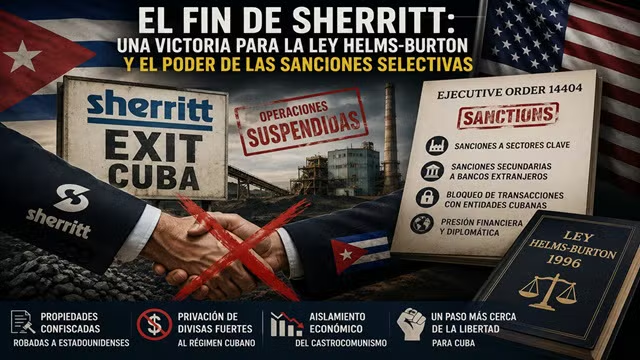
 The End of Sherritt: A Victory for Helms-Burton and the Power of Targeted Sanctions
After more than three decades of open defiance, Sherritt International—the Canadian company dubbed by Bloomberg in 1995 and once hailed as Fidel Castro’s “favorite capitalist”—has been forced out of Cuba. On May 7, 2026, Sherritt announced the immediate suspension of all its direct operations in the island’s joint ventures. The trigger was President Donald Trump’s Executive Order 14404, signed on May 1, which expanded sanctions on key sectors and imposed secondary sanctions on foreign banks dealing with blocked Cuban entities. What the Cuban regime celebrated as an exemplary partnership for 35 years collapsed in a single week. This outcome powerfully validates the Helms-Burton Act, particularly its Title III, and demonstrates that sustained, targeted American sanctions against the Castro-Communist regime deliver concrete results by starving it of hard currency.
Sherritt’s journey into Cuba exemplified a deeply concessionary capitalist relationship that fused the regime’s control of expropriated resources with Western capital, technology, and market access. Founded in 1927 as Sherritt Gordon Mines Limited, the company faced near insolvency by 1990. Under Ian W. Delaney—who openly displayed a family photo with Castro and called Cuba his favorite—it turned to Havana in 1991 amid the Soviet collapse and Cuba’s “Special Period.” The linkage of the Moa nickel deposit and Cuba’s processing capacity with Sherritt’s Alberta refinery and its access to low-cost energy proved a stroke of genius for both parties. In December 1994, Sherritt formed a 50/50 joint venture with Cuba’s Compañía General de Níquel de Cuba. The partnership quickly proved profitable, posting $14.3 million in earnings on $131 million in sales in its first quarter.
Cuba gained far more than a mere investor. It secured a reliable international market for its nickel concentrate, access to technological advancements unavailable since 1959, and Sherritt’s managerial expertise. These inputs drove dramatic improvements in productivity, energy efficiency, environmental performance, and health and safety standards. Nickel production at Moa soared from around 12,500 tons in the early 1990s to approximately 34,000 tons in the 2010s. Through this vertically integrated operation—from extraction and concentrating to refining in Alberta and global marketing—Cuba became joint owner of a world-class nickel enterprise.
The communist regime was able to access new technologies and know-how in oil and gas extraction, utilization, and electricity generation via Energas. With the world’s fifth-largest nickel reserves and tenth-largest production volumes, nickel became Cuba’s largest merchandise export after sugar’s collapse. Foreign exchange earnings from the Sherritt-Cuba joint venture accounted for an average of about 40% of the country’s total nickel and cobalt exports. Sherritt expanded aggressively into oil, gas, power (reaching 10-15% of national capacity), telecommunications, tourism, and agriculture, becoming Cuba’s largest foreign direct investor.
This was no arms-length transaction. The Castro government became a partial owner of Sherritt’s Alberta refinery, while Sherritt profited handsomely from assets the regime had stolen from American owners after 1959—including the former Moa Bay Mining Company, expropriated in 1960 and valued at $88.3 million. Over 35 years, Sherritt extracted well over 3 billion pounds of nickel. In 2024 alone, its Cuban revenues reached $109.9 million. Yet the regime chronically failed to honor payments, saddling Sherritt with hundreds of millions in unpaid receivables—later partially addressed through a 2022 “cobalt swap.” In practice, the dictatorship enjoyed capitalist efficiencies while retaining full political control and treating Sherritt as both partner and cash machine.
Washington rightly refused to tolerate this arrangement. The 1996 Helms-Burton Act delivered an immediate rebuke. Title IV imposed visa bans on Sherritt executives, major shareholders, spouses, and children—the first worldwide application. In his first term, President Trump activated Title III, enabling lawsuits against traffickers in confiscated properties and sending Sherritt’s stock plummeting. Trump’s 2026 Executive Order 14404 went further, targeting entire sectors and foreign financial enablers. Sherritt’s exit—marked by board resignations, a 30% stock drop, and staff repatriation—demonstrates the effectiveness of this pressure. Even as the partnership delivered technological and managerial upgrades to Cuba, it kept the repressive regime afloat with critical hard currency.
Critics have long dismissed these sanctions as ineffective and “offensive to international trade.” The Sherritt saga proves otherwise. By systematically denying the regime access to hard currency and international finance, sanctions compounded its structural failures, culminating in severe fuel shortages, temporary operational suspensions, and ultimately Sherritt’s full withdrawal. This is precisely the intended outcome. Cutting off vital revenue streams that sustain political repression, enrich powerful military entities like GAESA, and prop up a failed communist system are the reasons for the sanctions.
It is important to clarify a potentially misleading claim made in the U.S. State Department’s May 7 announcement. While GAESA is said to control approximately 40% of the Cuban economy, this figure significantly understates the regime’s true economic dominance. In Cuba’s totalitarian communist system—where private property is severely restricted and the state owns the commanding heights of the economy—GAESA, together with other regime-controlled state- owned enterprises and parastatal entities, exercises effective control over 85% to 95% of formal economic activity. GAESA dominates the most lucrative, dollarized sectors such as tourism, imports, retail, ports, and remittances, but the broader state apparatus maintains near-total command over industry, agriculture, energy, banking, and foreign trade. The 40% figure, therefore, masks the reality of a fully regime-controlled economy in which virtually all significant revenue streams ultimately serve the Castro-Communist dictatorship.
The conclusion of this immoral relationship must now serve as a springboard for far more aggressive action. U.S. policymakers should immediately escalate by directing the Treasury and Justice Departments to trace, freeze, and seize GAESA-controlled funds and assets in foreign banks through broadened secondary sanctions and international cooperation. Criminal indictments should be issued against executives and companies that traffic in stolen U.S. properties, treating these activities as racketeering under American law. Simultaneously, Washington must launch a full-spectrum intelligence investigation into the regime’s narcotics trafficking networks and sanction all identified facilitators and enablers.
Every dollar denied to the Cuban dictatorship is a dollar that does not fund surveillance, political prisons, or the machinery of repression. The Sherritt case stands as compelling evidence: Helms- Burton and complementary sanctions work. They expose willing accomplices, deter future ones, and accelerate the economic isolation of Castro-Communism. Policymakers in Washington should treat this victory not as an endpoint, but as a mandate to press the advantage relentlessly—until the regime has no choice but to yield under the weight of its monstrosity.
© The CubanAmerican Voice. All rights reserved.
 🖋️Author Julio M. Shiling
Julio M. Shiling is a political scientist, writer, columnist, lecturer, media commentator, and director of Patria de Martí and The CubanAmerican Voice. He holds a master’s degree in Political Science from Florida International University (FIU) in Miami, Florida. He is a member of The American Political Science Association, The PEN Club (Cuban Writers in Exile Chapter) and the Academy of Cuban History in Exile.

