
 A Tale of Two Cities: Havana and Washington on May Day
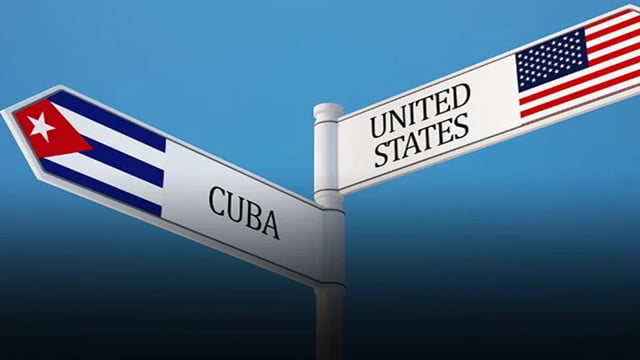
May 1, 2026, exposed two radically opposing political realities unfolding ninety miles apart. In Havana, the Cuban communist dictatorship attempted to stage its annual revolutionary spectacle amid visible fear, militarization, and growing insecurity. In Washington, the United States escalated its confrontation with the Castro-Communist regime through a sweeping executive order targeting the financial, political, and repressive architecture sustaining the dictatorship. The contrast was striking: one government desperately trying to manufacture the illusion of monolithic support; the other formally declaring the Cuban regime a continuing threat to U.S. national security and democratic values.
In Havana, the regime had originally planned a massive May Day mobilization at the Plaza Cívica — the monumental square later renamed Plaza de la Revolución after Fidel Castro consolidated communist rule. Historically, the plaza has served as the dictatorship’s preferred stage for choreographed demonstrations of revolutionary unity, giant propaganda rallies, and displays of ideological obedience. But this year, the regime abruptly relocated the main event to the so-called “Anti-Imperialist Tribune” in front of the U.S. Embassy. The explanation offered by state propaganda was predictable revolutionary theater. The real reasons were far more revealing..
The dictatorship feared poor turnout, despite available mass mobilization mechanisms. It feared images of half-empty plazas circulating across social media and independent outlets. More importantly, it feared the possibility of social unrest and spontaneous protest, particularly after the trauma inflicted on Cuban communism by the July 11, 2021, popular uprising. Thousands of Cubans across the island openly challenged communist rule in the largest anti-government demonstrations in decades. The memory of those protests continues to terrify the ruling elite because they shattered the regime’s carefully cultivated myth of universal revolutionary loyalty.
Security concerns also weighed heavily on the regime’s calculations. The appearance of the visibly frail and decomposing tyrant Raúl Castro beside dictator Miguel Díaz-Canel transformed the event into less a celebration than a display of dictatorial continuity under siege. Castroism’s rhetoric was openly defiant and militant, sounding increasingly similar to the revolutionary absolutism and anti-Western hostility associated with the Iranian ayatollah regime, one of Havana’s closest ideological and geopolitical partners. This was not a workers’ celebration. It was a regime fortification exercise.
The communist dictatorship explicitly organized the May Day mobilization within the framework of the newly declared “Year of Defense Preparedness” for 2026. The Castroist regime has announced weekly military exercises, civil defense operations, and plans approved by the National Defense Council for a transition to a wartime footing in the event of conflict or internal instability. The atmosphere surrounding the parade reflected precisely that mentality. It is a state preparing not for prosperity or reform, but for confrontation and survival.
Military personnel, Ministry of the Interior (MININT) officers, intelligence agents, rapid- response brigades, and uniformed security forces maintained a heavy presence throughout the event. The symbolism was unmistakable. The regime increasingly governs Cuba, not as a confident political system, but as an entrenched security apparatus managing a population it fundamentally distrusts. The omnipresent deployment of coercive forces transformed what the dictatorship claimed was a celebration of workers into a demonstration of state intimidation and internal control. Rather than projecting revolutionary vitality, the spectacle exposed a government whose primary political instinct is surveillance, containment, and preparedness against its citizenry.
At the same time, the dictatorship attempted to manufacture legitimacy through mass political coercion. Havana triumphantly announced that more than 6.2 million signatures had been collected for the “Mi Firma por la Patria” (“My Signature for the Homeland”) campaign, a regime-driven initiative supposedly demonstrating national support for Cuban “sovereignty” and resistance to foreign pressure. In a totalitarian system, signatures gathered through workplaces, schools, party committees, unions controlled by the state, neighborhood surveillance networks, and government institutions cannot meaningfully be interpreted as free political expression. Participation in such campaigns is inseparable from intimidation, social pressure, and fear of retaliation. In Cuba, refusing to cooperate with state mobilizations can carry consequences ranging from professional marginalization to harassment, interrogation, or loss of opportunities controlled by the state.
The regime intended to project strength. Instead, it revealed insecurity. While Havana staged ideological rituals and militarized pageantry, Washington moved decisively in the opposite direction. On May 1, President Donald J. Trump signed an executive order titled Imposing Sanctions on Those Responsible for Repression in Cuba and Threats to U.S. National Security and Foreign Policy. The order represents another comprehensive sanction charter directed at the Cuban regime. It significantly expands the legal, financial, and diplomatic pressure against Castro-Communism.
The executive order declares that the actions and policies of the Castro government continue to constitute an “unusual and extraordinary threat” to U.S. national security and foreign policy. It further states that the regime’s conduct is “repugnant to the moral and political values of free and democratic societies.” The sanctions provisions are sweeping in scope. Under Section 2, the United States can block all property and interests in property under U.S. jurisdiction belonging to foreign individuals or entities operating in strategic sectors of the Cuban economy, including defense, energy, mining, metals, financial services, and security. The order specifically targets not only officials of the Castro government but also individuals and entities acting on behalf of the regime, those materially assisting it, and those providing financial, technological, or logistical support.
The order further authorizes sanctions against persons complicit in serious human rights abuses or corruption connected to communist Cuba, including expropriation of private assets, misappropriation of public resources, bribery, and political profiteering by regime officials. Even adult family members of sanctioned individuals may be designated. The message is unmistakable: the United States intends to target not merely isolated actors, but the broader ecosystem sustaining the dictatorship. By extending liability beyond formal state officials to financial enablers, intermediaries, and beneficiaries of regime corruption, the order seeks to penetrate the patronage networks that have long insulated Cuba’s ruling elite from meaningful accountability.
The executive order also dramatically raises pressure on international financial institutions. Foreign banks facilitating significant transactions for sanctioned Cuban individuals or entities may themselves face severe penalties, including restrictions on correspondent banking access in the United States or the blocking of assets under U.S. jurisdiction. These secondary sanctions substantially increase the financial risks associated with doing business with the Cuban regime. In practical terms, the measures are designed to further isolate Havana from global financial networks and deter foreign actors from serving as economic lifelines for the dictatorship.
Additionally, the order imposes a travel ban on foreign nationals tied to sanctionable activities connected to the Cuban government, suspending unrestricted immigrant and nonimmigrant entry into the United States for designated individuals. It also prohibits transactions designed to evade sanctions and authorizes aggressive enforcement under existing emergency powers legislation. The inclusion of immigration restrictions underscores that participation in repression and corruption in Cuba may now carry not only financial consequences, but also personal and diplomatic isolation from the United States.
Thus, May Day 2026 became far more than a symbolic holiday. In Havana, the regime attempted to choreograph revolutionary permanence through coercion, militarization, and ideological spectacle. It visibly displayed a deep-rooted fear of its population. In Washington, the United States formally intensified its economic and diplomatic campaign against the structures of Castro-Communist repression. Two cities, two systems, and two entirely different conceptions of political legitimacy.
One clings to power through surveillance, compulsory mobilization, and security-state control. The other increasingly signals that the Cuban dictatorship’s repression, corruption, and destabilizing conduct will face mounting consequences. The juxtaposition of Havana’s militarized choreography and Washington’s expanding sanctions policy underscored the growing collision between a system struggling to preserve totalitarian permanence and an American political environment becoming progressively less willing to tolerate or normalize its existence. Havana’s pathetic May Day spectacle revealed their inability to effectively orchestrate anything convincing. It also underscored their pathological refusal to negotiate themselves out of power. The U.S. must now seize the moment and take its legitimate national security concerns to another level.
© The CubanAmerican Voice. All rights reserved.
 🖋️Author Julio M. Shiling
Julio M. Shiling is a political scientist, writer, columnist, lecturer, media commentator, and director of Patria de Martí and The CubanAmerican Voice. He holds a master’s degree in Political Science from Florida International University (FIU) in Miami, Florida. He is a member of The American Political Science Association, The PEN Club (Cuban Writers in Exile Chapter) and the Academy of Cuban History in Exile.

