
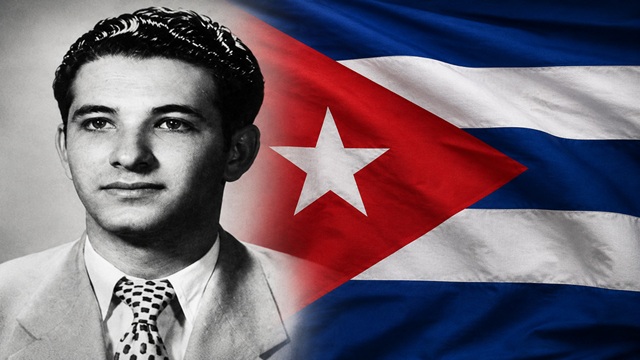
 Honoring Pedro Luis Boitel and the Demand for Accountability
This coming Monday, May 25, 2026, marks the 54 th anniversary of the death of Pedro Luis Boitel, a courageous Cuban patriot and emblematic victim of the Castro regime’s brutal political prison system. Boitel died on May 25, 1972, after enduring 53 days on a hunger strike. He had launched the protest to denounce the inhumane treatment of political prisoners and the regime’s arbitrary extension of his sentence. Despite his critical condition, authorities failed to provide adequate medical care when he was moved to the prison infirmary.
Boitel’s death was entirely preventable. The Castro-Communist regime chose to let him perish. His sacrifice remains a powerful symbol of the thousands of Cubans who have suffered torture, dehumanization, and extrajudicial killing under more than six decades of communist rule. Boitel’s story continues to expose the systematic cruelty that defined Cuba’s prisons and the regime’s ruthless suppression of dissent. A horrific fact that remains true to this day.
Last Wednesday, May 20—Cuba's Independence Day—an important development occurred when dictator Raúl Castro was formally indicted for the 1996 murder of four humanitarian pilots and crew members of Brothers to the Rescue: Carlos Costa, Armando Alejandre Jr., Mario de la Peña, and Pablo Morales. The two civilian aircrafts were shot down in international waters while on a mission to aid Cuban rafters fleeing the island. This indictment, though long overdue, serves as a timely reminder that even the most powerful figures of the regime are not beyond the reach of justice. Time does not contain its exercise when the crime is of this proportion.
Raúl Castro’s advanced age should evoke no pity. The soul knows no calendar. At 94, he remains the same man, with the same soul. In 1959, for example, he ordered the Massacre of San Juan Hill, one of the most notorious mass executions in modern Latin American history, where 71 individuals were mercilessly shot without any due process. Hundreds of summary executions received his endorsement. The system that he, along with his older brother, concocted oversaw the killing, torture, and dehumanization of thousands of Cubans. In the Latin American context, by way of their Marxist revolution export business, the victims list grows to the hundreds of thousands. Raúl Castro’s physical body may be decaying, but the malicious soul that drove those crimes has never changed.
As we remember and honor Pedro Luis Boitel this Monday, the recent indictment against Raúl Castro stands as a fitting prelude. It reinforces a vital truth. Justice may be delayed for decades, but it must not be ignored. Boitel was killed 54 years ago. The Brothers to the Rescue volunteers were murdered 30 years ago. In both cases, the perpetrators bear full responsibility. These anniversaries remind us that heinous crimes against humanity carry no statute of limitations.
The convergence of these two dates carries deep significance for the Cuban people. As the prospect of a free and democratic Cuba grows stronger, the nation must consciously embrace the imperative of justice. A future democratic government—or any transitional authority, even if temporarily operated by the United States—should place comprehensive transitional justice at the very cornerstone of its mission. This includes truth-seeking, accountability for the killers and torturers, reparations for victims and their families, and the moral restoration of a nation long scarred by repression.
The memory of Pedro Luis Boitel demands nothing less. His death was not in vain if it continues to inspire the pursuit of justice for all who suffered under the Castro regime. The indictment of Raúl Castro should be celebrated not merely as a legal action but as a powerful signal that the long era of impunity is coming to an end. Cubans both on the island and in exile must internalize this message. Justice is not optional. It is essential for genuine national reconciliation and the construction of a truly free society. Let us properly honor Boitel by committing ourselves to the idea that no crime this monstrous can remain forever unpunished. Justice delayed for more than half a century is still justice. This is the case, even if it is long overdue.
© The CubanAmerican Voice. All rights reserved.
 🖋️Author Julio M. Shiling
Julio M. Shiling is a political scientist, writer, columnist, lecturer, media commentator, and director of Patria de Martí and The CubanAmerican Voice. He holds a master’s degree in Political Science from Florida International University (FIU) in Miami, Florida. He is a member of The American Political Science Association, The PEN Club (Cuban Writers in Exile Chapter) and the Academy of Cuban History in Exile.

