
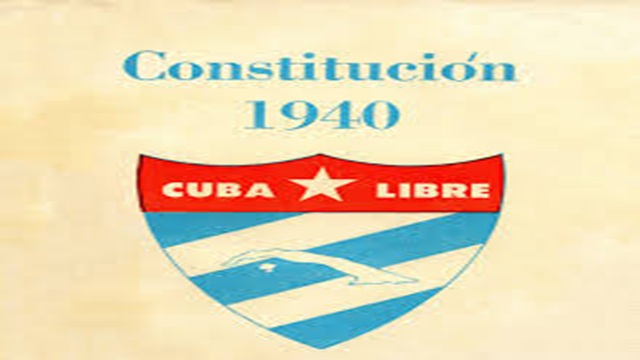
 The 1940 Constitution: Cuba’s Democratic Bridge
The possibility of a successful democratic transition in Cuba rests upon two historic advantages that distinguish the Cuban case from many other societies emerging from totalitarian rule. These advantages are interconnected and mutually reinforcing. Cuba possesses a republican tradition upon which democratic reconstruction can be built, and the Cuban nation that survived in exile preserved the cultural identity, historical memory, and civic traditions that the Castro-Communist regime attempted to erase. Together, these two realities provide the foundation for a constitutional renewal rooted not in political invention but in historical restoration.
The first advantage is Cuba’s own republican experience before 1959. Contrary to the historical narrative promoted by the Castro regime, Cuba was not a society without democratic foundations waiting to be liberated by revolutionary rule. Between independence in 1902 and the destruction of the constitutional order in 1959 (first derailed in 1952), Cuba experienced a functioning—although imperfect—republic. There were political parties representing different ideological currents, competitive elections, peaceful transfers of power, an active civil society, independent institutions, and a political culture shaped by constitutionalism. Cuba experienced periods of authoritarian interruption, particularly during military regimes, but these episodes did not destroy the foundations of republican life. Civil society remained vibrant, political pluralism survived, and the essential idea of Cuba as a constitutional republic endured.
The second advantage is the survival of the Cuban nation beyond the island itself. The millions of Cubans who went into exile did not merely carry personal belongings or memories of a lost homeland. They carried Cuba’s traditions, values, historical consciousness, religious practices, cultural expressions, and understanding of national identity. The exile community became a custodian of a historical continuity that the communist state sought to sever. This preservation of identity is essential because democratic transitions are not only institutional transformations; they are also acts of national reconstruction. A society emerging from totalitarianism must recover its own historical narrative after decades of ideological manipulation.
For this reason, the 1940 Constitution represents a uniquely appropriate constitutional vehicle for Cuba’s democratic transition. The 1940 Constitution was the last legitimate constitutional text produced by a freely elected constitutional assembly representing Cuba’s major political forces and social sectors. It was the supreme expression of Cuba’s republican era and embodied the constitutional aspirations of the nation before the destruction of democratic governance. Unlike the Castro-Communist constitutional framework imposed after 1959, the 1940 Constitution emerged from popular sovereignty rather than revolutionary authority.
A democratic transition after communism must confront the past. This includes accountability for abuses, recognition of victims, restitution and reparations, institutional reform, and guarantees that dictatorial rule does not return. These are the essential components of transitional justice. Yet democratic reconstruction requires more than dismantling the structures of dictatorship. It also requires reconnecting a society with the legitimate historical foundations that preceded tyranny.
The restoration and modernization of the 1940 Constitution accomplishes both objectives. It provides a constitutional bridge between Cuba’s past and future. It allows Cubans to reconnect with their authentic republican tradition rather than accept the historical narrative constructed by Castro-Communism, which portrayed pre-1959 Cuba as a failed society requiring total ideological replacement. The regime attempted to redefine Cuban history around itself, treating everything before 1959 as morally illegitimate. A democratic Cuba must reject this historical rupture and recover the broader national story that existed before totalitarian rule.
Critics often misunderstand the proposed use of the 1940 Constitution by assuming that it would be applied exactly as written in 1940. That is not the proposal. Transitional constitutionalism requires flexibility. The interim governing authority would adopt the 1940 Constitution as the legitimate constitutional foundation of the transition while immediately suspending most provisions. During the transition period—ideally lasting several years—the country would be governed through emergency democratic decrees designed to stabilize institutions, restore rights, implement transitional justice, and prepare for elections.
The fundamental rights protections contained in Title IV of the 1940 text would provide an immediate constitutional anchor. These provisions include equality before the law, protection against discrimination, habeas corpus, due process guarantees, freedom of speech, freedom of the press, freedom of assembly, freedom of religion, protection of private property, and the right of citizens to resist tyranny. These principles remain foundational to any democratic order.
Other sections of the 1940 Constitution also contain valuable institutional mechanisms worthy of preservation. Title V provides important protections for family, education, and culture. Titles XV and XVI establish meaningful municipal and provincial autonomy, limiting excessive centralization. Title XIV recognizes the importance of judicial independence and judicial review. Title XVII includes significant mechanisms of financial oversight through the Tribunal de Cuentas, a powerful anti-corruption institution capable of monitoring public finances.
After free, fair, and competitive elections, a democratically elected parliament could convene a constituent assembly responsible for modernizing the constitutional text. The resulting document would incorporate contemporary democratic standards, economic realities, and institutional safeguards. It would then be submitted to the Cuban people through a national referendum. The purpose of preserving the 1940 Constitution during transition is therefore not nostalgia; it is continuity, legitimacy, and national reconciliation.
The alternatives present serious problems. One option would be to retain and merely reform the current Castro-Communist constitutional text. This would be a profound mistake. That document emerged from totalitarian rule and lacks democratic legitimacy. Reforming it would risk preserving the legal foundations of the very system that transitional justice must dismantle.
The second option would be to create an entirely new constitution from nothing. While this may appear neutral, it would repeat one of the central errors of Castro-Communism: severing Cuba from its historical development. A new constitution without historical continuity would suggest that democratic Cuba has no roots, no inheritance, and no institutional memory. That would echo the revolutionary claim that the nation began anew in 1959.
Cuba is not a democratic orphan. It possessed an imperfect but functioning republic that was violently interrupted, not naturally exhausted or historically discredited. Its constitutional traditions, civic institutions, political culture, and national identity existed before the revolutionary rupture and survived despite decades of ideological transformation imposed from above. The democratic project after Castro-Communism should not invent a nation; it should restore and renew one. The Cuban democratic transition should recognize that Cuba’s future legitimacy will depend not only on building new institutions but also on reconnecting those institutions to the historical memory of the Cuban people. This includes embracing the constitutional ideals that preceded communist tyranny. A free Cuba must recover the understanding that democracy is not an import but a national inheritance.
Some objections to the 1940 Constitution deserve consideration. Some mistakenly describe it as a socialist constitution. This reflects confusion between socialism and social democracy or Christian democratic traditions. The constitutional assembly of 1939 included communists, but they represented only a minority. The document was primarily shaped by Cuba’s mainstream political traditions: liberals, conservatives, social democrats, and other democratic forces. Its social provisions reflected the constitutional trends of the twentieth century, not communist ideology.
Others argue that the Constitution is outdated. Age alone, however, does not determine constitutional value. Many successful democracies continue to rely on historic constitutional texts because legitimacy often comes from continuity as much as from contemporary drafting. The strongest criticism is that the 1940 Constitution is excessively detailed and attempts to regulate areas that modern constitutions typically leave to legislation. This criticism has merit. It is precisely why modernization is necessary. The objective is not to preserve every article but to preserve the constitutional lineage.
The most important question is not whether Cuba should return mechanically to 1940. The question is whether a free Cuba should reconnect with its own constitutional heritage. The answer should be yes. The 1940 Constitution offers something essential after decades of kleptocratic communist dictatorship: legitimacy, historical continuity, and healing. By adapting this historic document to modern democratic realities and submitting it to popular approval, Cuba can begin reconstruction not as a nation searching for an identity, but as a nation reclaiming one.
© The CubanAmerican Voice. All rights reserved.
 🖋️Author Julio M. Shiling
Julio M. Shiling is a political scientist, writer, columnist, lecturer, media commentator, and director of Patria de Martí and The CubanAmerican Voice. He holds a master’s degree in Political Science from Florida International University (FIU) in Miami, Florida. He is a member of The American Political Science Association, The PEN Club (Cuban Writers in Exile Chapter) and the Academy of Cuban History in Exile.

