
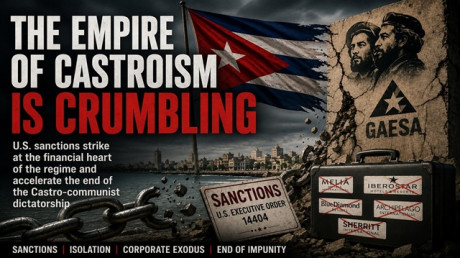
Castroism’s Empire Crumbles
- 06-05-2026Castroism’s Empire Crumbles Leer en Español For decades, opponents of economic pressure against the Castro-Communist regime insisted that sanctions did not work. According to this conventional...
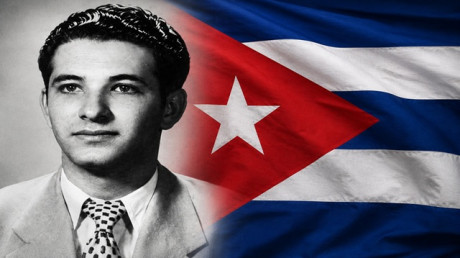
Honoring Pedro Luis Boitel and the Demand for Accountability
- 05-22-2026Honoring Pedro Luis Boitel and the Demand for Accountability Leer en Español This coming Monday, May 25, 2026, marks the 54 th anniversary of the death of Pedro Luis Boitel, a courageous Cuban...
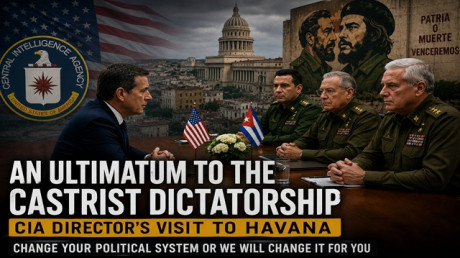
The CIA Director’s Visit to Havana: An Ultimatum in Broad Daylight
- 05-15-2026The CIA Director’s Visit to Havana: An Ultimatum in Broad Daylight Leer en Español The sight is repulsive on its face. A high official of the United States government, the world’s leading...
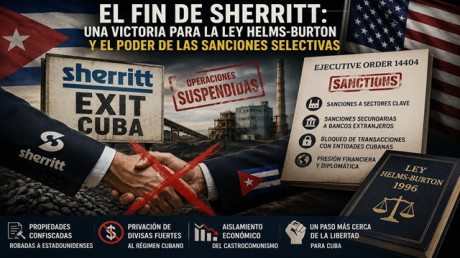
The End of Sherritt: A Victory for Helms-Burton and the Power of Targeted Sanctions
- 05-08-2026The End of Sherritt: A Victory for Helms-Burton and the Power of Targeted Sanctions Leer en Español After more than three decades of open defiance, Sherritt International—the Canadian company...
A Tale of Two Cities: Havana and Washington on May Day
- 05-01-2026A Tale of Two Cities: Havana and Washington on May Day Leer en Español May 1, 2026, exposed two radically opposing political realities unfolding ninety miles apart. In Havana, the Cuban communist...
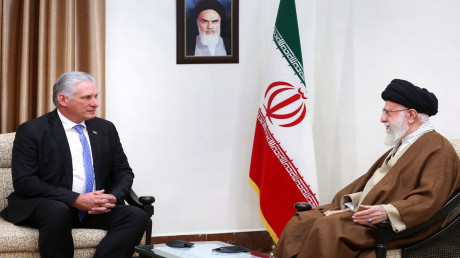
Crush Castroism Now to Finish Islamic Iran
- 04-17-2026Crush Castroism Now to Finish Islamic Iran Leer en Español The Islamic Republic of Iran is reeling. Its senior leadership has been decapitated, its missile factories and air defenses lie in ruins,...
Cuba’s Spy State Next Door: Time to End the Castro Regime
- 04-09-2026Cuba’s Spy State Next Door: Time to End the Castro Regime Leer en Español The recent announcement by the Federal Bureau of Investigation (FBI) confirming that communist Cuba has functioned as a...

Remember the Combative Christ During Holy Week
- 04-01-2026Remember the Combative Christ During Holy Week Leer en Español A dangerous distortion has crept into Christian theology across Catholic, Protestant, and Orthodox traditions alike. Jesus is recast...

Helms-Burton Locks in Regime Change for Cuba
- 03-27-2026Helms-Burton Locks in Regime Change for Cuba Leer en Español As Donald J. Trump advances his second term with a bold initiative in Cuba, Secretary of State Marco Rubio is playing a central role in...
- Details
 Herbert Marcuse and Biden’s Illiberal Propaganda Ministry
Here, the biggest enemies are domestic. A propaganda ministry is another manifestation of this fact.
George Orwell, the disillusioned former socialist writer, outlined it well in two of his classic political satires, Animal Farm (1945) and 1984 (1949). The importance of controlling the media narrative, the news, and public discourse are fundamental if one is to set up a dictatorship. As for totalitarian regimes (the worst kind), a monopoly on the means of communication and the information (or misinformation) that emanates from it, is a centerpiece of its organizational structure. The Biden administration is seeking to institute a political police agency within one of the federal government’s departments, none other, than Homeland Security (DHS). The labeled “Disinformation Governance Board” is an action plan that emanates, most boldly, from cultural Marxism (or Neo-Marxism).
The KGB dedicated most of its agency’s vast resources to disseminating disinformation. The post-Soviet despotic model, designed and currently stewarded by Vladimir Putin, has continued, and built on this infamous legacy. Free expression and the availability of plural viewpoints that are uncensored by the government or private quasi-monopolies are essential for a republic. The infringement of basic rights of thought, expression, and exchange of ideas in peaceful assembly is inherently paramount for a functioning democracy, measures akin to a Ministry of Truth or Propaganda are antithetical to a free society. The biggest threat to the U.S. today is a domestic minority. This elite, oligarchy is composed of Barack Obama’s Democratic Party, mainstream media, Big Tech, and the nation’s woke capital and investment firms.


Read more: Herbert Marcuse and Biden’s Illiberal Propaganda Ministry
- Details
 Is Ukraine Receiving Western Aid to Survive but Not Defeat Russia?
Ukraine must not just avoid a collapse. Russia must be defeated in the country they invaded.
Few people would have given Ukraine much hope on when the Russian invasion began. Surprisingly, over two months later, Europe’s biggest landmass country is still free and sovereign. The world’s second-largest army has been humiliated in the battlefield. The main objective: capturing Kyiv, killing President Volodymyr Zelenskyy, and installing another puppet government, has failed. Given these facts, many are wondering if Ukraine is receiving Western aid only in the amount and quality necessary to not collapse, but not enough to defeat Russia...
The Russian occupiers have lost 25% of their invading forces. Among the human losses, have been over 10 high-level Russian military commanders. Military experts concur that when this scenario unfolds, your troops are suffering defeat and forcing them closer to the front lines. There are many reasons one can give to explain the field superiority of the Ukrainians. Russia’s army is stiff and follows a highly centralized military structure. The Ukrainians, on the other hand, have brilliantly adopted Napoleonic strategies which exploits chaos and renders flexibility to field commanders. The numbers speak for themselves. Given this fact, why is the U.S. and NATO withholding their most advanced offensive weaponry?
American intelligence has been pivotal in partially explaining this epic Ukrainian success story. Logistics alone, however, will not suffice. On the military front, Ukraine has been requesting Patriot missiles, fighter jets, and smart offensive missiles to capitalize on Russia’s vulnerabilities. This has not come about. Defensive weapons seem to be the thrust of the West’s generosity. Wars are not won, however, limited to defensive infliction. It is a good thing that Ukrainian military commanders have been given autonomy in making military decisions in the field, instead of receiving instructions from Brussels or Washington.
The economic sanctions against the Putin regime have been spectacular. While it is true that these similar measures have no historic precedent, they are still insufficient. Since Russia invaded Ukraine, the West has transferred $66 billion in fossil fuel related purchases to the Russian dictator. This helps fund the Russian war machine. This finances the Russian genocide against the Ukrainian nation. The West’s financial institutions have limited Putin’s banks, but they have not derailed them totally. This leaves avenues that allow the evasion of the West’s intention of denying Russia the resources to continue its aggression. Everyone knows what needs to be done. Since the Soviet days, the Eurasian depends on oil and gas exports for their survivability. The U.S. and oil producing allies have the capability to replace the Russian market. Why isn’t this happening?
If one accepts the argument that the West does not want the legitimate government of Ukraine to collapse, but it also does not want Russia to be defeated, the issue becomes a tragic paradox. One could make the argument that a prolonged war in Ukraine could bleed the Putin regime to death, resulting in its overthrow. Those that take this view are using Ukrainian lives and wealth for this purpose. Another position is that if Putin is defeated, the Russian dictator will go ballistic and make true on his nuclear blackmail. This defeatist position, which is antithetical to the West’s Cold War strategy of Mutually Assured Destruction, casts aside the very nature of the victory of democracy and capitalism over Soviet communism.
The West must stop this piecemeal approach to aiding Ukraine. The immorality of using the Ukrainian people as pawns to crush the Putin regime goes against the values which Western civilization represents. The Ukrainian armed forces have already proved that they can defeat the Russian invaders. Since 2014, Ukraine has been preparing for a full-fledged Russian invasion. American and NATO military personnel knew that. They helped train the Ukrainians. Give them the weapons they need and starve the Russian war monster once and for all. Putin’s off ramp will come quicker, the more his regime suffers. Ukraine must not just avoid a collapse. Russia must be defeated in the country they invaded.
©The Cuban American Voice. All rights reserved. Reproduction is prohibited without express permission.
 🖋️Author Julio M. Shiling
Julio M. Shiling is a political scientist, writer, columnist, lecturer, media commentator, and director of Patria de Martí and The CubanAmerican Voice. He holds a master’s degree in Political Science from Florida International University (FIU) in Miami, Florida. He is a member of The American Political Science Association, The PEN Club (Cuban Writers in Exile Chapter) and the Academy of Cuban History in Exile.
- Details
 Why Florida is the Gold Standard for Election Integrity
Voting integrity and transparency laws fight to keep a republic from dying.
Consensual government is a small spec in the large mass of human history. Popular sovereignty in a constitutional republic is contingent upon a set of preconditions. Among the prerequisites are freedoms of expression, assembly, press (and social media), systemic checks and balances, fair, free, and periodic elections, and a vibrant civil society. The legitimacy of the democratic model rests on the citizenry believing in the system. Florida’s new comprehensive election integrity law is a gold standard for America.
The premier problem for self-government is when the election system is corrupted with schemes that put into question the authenticity of the popular will. In other words, when cheating occurs in the vote-counting or electoral policies that favor one side over the other, the system’s validity is doubted. The 2020 election was plagued with irregularities, that included questionable mail vote procedures, a constitutional dislocation of electoral law tampering, as well as a coordinated, multifaceted effort by private entities such as Big Tech, mainstream media, and high-profile personalities. All acted with the expressed intent to defeat the Republican candidate.
Numerous polls have concluded that close to half of America believes the 2020 election was rigged. One of these surveys, the Politico/Morning Consult poll, for example, determined that after the election, 70 percent of Republicans did not find it to be either free or fair. The success of the democratic model of governance cannot long endure without sustaining ample support of the people. When such a high proportion of the voting population disbelieves the authenticity of the election process, the system’s legitimacy is imperiled. This is why systemic safeguards to assure the probity of the election model are fundamental.
On Monday, April 25, Gov. DeSantis signed in to Florida law, SB 524. This administration legislation addresses most of the potential areas for voting dishonesty. Critics, mainly composed of those who applauded or were proactive in implementing the discredited 2020 electoral shenanigans, are labeling SB 524 as a “police force” or an “anti-voter” measure. Florida’s comprehensive election integrity does not curtail voting rights. Far from it. What it does do is make it difficult to commit electoral fraud. Additionally, it would curtail “legal” activities that undermine federal election laws.
Dirty voter rolls are a major problem. As people die, move out of a voting jurisdiction, or become ineligible to vote for any other reason, often their names remain on voting rosters for years. This lends itself to potential abuse and fraud. The solicitation of mail-in ballots must contain the assurances that the person requesting the ballots is who he says he is. Identity verification is paramount to keep the system as clean as possible. Ballot harvesting abuse is as old as corruption. This activity breeds fraudulent pursuits and must be tackled. Unsecured ballot “drop boxes” are an invitation to vote manipulation and privacy infringements. Finally, the use of private funds in public elections that end up benefiting some candidates or a particular party over the other, violates the equal protection clause of the Constitution and evades federal election campaign finance limitations.
Florida’s election administration law addresses all the mentioned areas of potential election cheating and system vulnerabilities. SB 524 arms the Department of State (DOS) with the resources to focus on prioritizing election purity as an official Florida state policy. An Office of Election Crimes and Security would work under the auspices of the DOS. It will be empowered to receive information concerning voter fraud claims and investigate substantiated cases with law enforcement, as well as enforce the law’s comprehensive integrity measures.
Included in the Sunshine State’s election protection procedures is the requirement that election supervisors purge ineligible voters from voting rolls on a yearly basis. The DOS would be instructed to strengthen ID requisites for mail-in ballot solicitations, in addition to signature verification for all voters. Criminal penalties would be increased for ballot harvesting, an abusive practice that exploits vulnerable citizens. SB 524 also would prohibit election supervisors from accepting “Zuckerbucks,” or other forms of dark money, which contaminate public elections.
A republic is contingent upon a free people expressing their will at the ballot box. Whether this is done by voting in person on election day or earlier in anticipated voting, by mail or other absentee methods, the governed have a right to a trustworthy election system. This is not a partisan issue. Fair and free elections are inherently fundamental to a democracy’s viability. Voting integrity and transparency laws fight to keep a republic from dying. Florida is, again, setting the standard.
©The Cuban American Voice. All rights reserved. Reproduction is prohibited without express permission.
🖋️Author Julio M. Shiling
Julio M. Shiling is a political scientist, writer, columnist, lecturer, media commentator, and director of Patria de Martí and The CubanAmerican Voice. He holds a master’s degree in Political Science from Florida International University (FIU) in Miami, Florida. He is a member of The American Political Science Association, The PEN Club (Cuban Writers in Exile Chapter) and the Academy of Cuban History in Exile.
- Details
Taking Cues from America’s Left? The Cuban Assault on Parental Rights, Explained.
Pastor Mario Lleonart emphasized, in a conversation with Julio M. Shilling, that the measure in Cuba would be a response to the protests that took place on July 11.

AUTHOR 04.27.22 2 MINUTE READ
A new family-related law in Cuba eliminates the figure of “parental authority” allowing parents to have even less authority over their children, and this role to be supplanted with more force by the totalitarian State.
Is this a response to the unprecedented protests of July 11, 2021, and another mechanism to control those who oppose them? Gay marriage in exchange for the upbringing of our children? What is the scenario we are facing and how does this connect with international events and the agenda of the international left?
“It’s the latest cry of Cuba’s dictatorship”
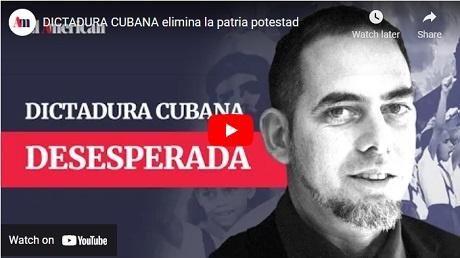
“It seems to me the latest cry of the dictatorship that is desperate and wants to take to paper and wants to take to paper what it has ultimately tried to do for these decades, which has been maintained by force, but now has the nerve to try to take this to paper to make it mandatory and law”, Lleonart explained.
He stressed that the measure would be a response to the protests that took place on July 11, 2021. However, he indicated that it was something they had been preparing since before. ...
