
 Racism and the Economy Were not the Causes of the 2021 Cuban Uprising.
The racial factor is circumstantial and can only be sustained through the lens of Critical Theory of Race madness.
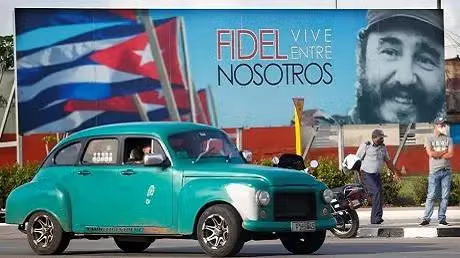
BBC News published an article on August 20 about the Cuban Uprising of July 11. The piece centered around the opinion of Alejandro de la Fuente, a historian and professor of African and African American Studies at Harvard University, on Cuba and the potential triggers of the cited popular protests throughout the Island. The relevancy of this work is strictly in its argument and why it must be reviewed and challenged. Racism and economics were not the causes of the massive demonstrations.
Titled “Protests in Cuba: ‘Those who protested on July 11 were the losers of state capitalism and among them are Afro-Cubans’,” the article presents a viewpoint that is representative of other works and opinions that present an alternate reality when it comes to the overarching reasons for the civic rebellion that transpired across Cuba on July 11. Whether intentional or not, the BBC News piece adds to a perspective, which bypasses the clear purpose of the Cuban people’s demands. Those familiar with de la Fuente’s work, know full well his monothematic, one-dimensional understanding of race relations in Cuba.


A Nation for All: Race, Inequality and Politics in Twentieth-century Cuba, de la Fuente’s most notable book, is a monumental work. The copious notes of enormous historical value that this book includes are intellectually enriching. For this, de la Fuente is to be commended. This work is a point of reference for research on Republican Cuba (1902-1958) and the U.S. occupation of the country (1898-1902) following the Cuban-Spanish-American War (1898). The sheer volume, quantitatively and qualitatively speaking, of citations and notes, again, is most impressive.
De la Fuente’s weakness does not lie in his ability at research or writing skills to argue his position. The weakest link in the Harvard professor’s work is the conclusions he draws from all the exquisite academic investigation. There is an underlying premise behind de la Fuente’s reading of the facts associated with black Cubans and historical race relations in Cuba. One of the defective elements prevalent in Critical Race Theory (CRT) and espoused by American Marxists, is found in his rationalization. While de la Fuente is not a Castro-Communist, he brings the notion of economic and other disparities between Cuban blacks and whites into a particular realm of thinking, and reaches his conclusions based on these factors, omitting other seminal variables which undermine his premise.
Responding as to why he believed racial inequality was pivotal in explaining the protests, de la Fuente stated for BBC News, “Because those who came out to protest on July 11 are the losers of the new state capitalism that has developed in Cuba over the last 30 years.” In effect, what the Cuban-born historian and prolific writer is saying is that the economic modifications in Cuba following the collapse of Soviet communism discriminated against Cuban blacks and, as a result, they massively protested to express their discontent. For purposes of clarity, the “reforms” that ensued the disappearance of the U.S.S.R. (and its subsidies), before Hugo Chávez’s ascension to power (1991-1999), consisted of expansions into numerous policy projects.
The post-Soviet state policy modifications in Cuba of the 1990s include: (1) allowing foreign investors to partake in mixed partnerships with the Castro regime; (2) expanding the operations of state-owned enterprises run by the military; (3) amplifying tourism for monetary and propaganda purposes; (4) broadening the neo-slave practice of leasing Cuban workforce personnel in the medical, sports, and other fields to foreign paying governments; (5) fostering an exodus to the U.S. with the intent of developing a Cuban exile and diaspora dependent economic order; (6) accommodating remittance schemes from abroad; (7) allowing small-scale, selectively limited non-state sector economic activities; (8) prioritizing rapprochement attempts to broker a deal with the U.S. on its dictatorial terms; and (7) orchestrating a new socialist non-democratic political model, with a reformulated methodology for attaining political power, for purposes of expanding socialism in the American continent (São Paulo Forum 1990).
“Racism and economics were not the causes of the massive demonstrations”. (EFE)
The “socialism with Cuban characteristics” variant (described above) — which was the response to the loss of Soviet subventions in the 1990s — was restructured in the mid 2000s and has continued as a steady stream of both reversions and flirtations with campaigns to attract foreign capital. The gargantuan expropriation of Venezuelan wealth and deepening involvement in drug trafficking has not meant that Communist Cuba would return to its pre-1990s’ economic order. While statistics do suggest that black Cubans, in general, have fared less favorably economically proportionately than whites over the last 30 years, it does not explain the full picture, much less make valid the broader claims made by de la Fuente.
The issue of skin color in understanding “disparities” is a symptomatic variable, not a causal one.
In the cited BBC News article, de la Fuente states that, according to the 2012 census (the last one taken), non-whites constitute 36% of the population. If 64% of the population is non-black, clearly, whites are a majority. The fact that most Cubans that have exited the Island are white and can send remittances, may explain the skin factor better. Yet, this falls short of the total truth. Mobile electronic devices have allowed us to bear witness to the evidence. The massive crowds that heroically took to the streets that Sunday (July 11th) in over 50 localities across Cuba were of all skin colors. Furthermore, all the grievances expressed by the protesting multitudes were unrelated to economic or racial considerations. There were no Black Lives Matter-like slogans anywhere.
Totalitarian regimes discriminate based on ideological fitness, regime servitude, and elite connection. The proposition that racism and economic “injustice” prompted the massive popular demonstrations is absurd. It is reductionist at best and evidences a colossal misunderstanding of the mechanics of the Cuban communist regime and its systemic setup. The race factor is circumstantial and can only be upheld through the lens of CRT folly. José Martí got it right when he said, “There is no race hatred, because there are no races” (“Our America” 1891).
What Cuba’s national hero insisted on was that the Cuban national identity served to fuse all races into a shared Cuban citizenship. True to Marti´s belief, the Cuban people on July 11, in their legitimate calls for freedom and the end of communism, spoke as one. They are “Cubans”, not white or black.
©The Cuban American Voice. Originally published in @El American. All rights reserved.
 🖋️Author Julio M. Shiling
Julio M. Shiling is a political scientist, writer, columnist, lecturer, media commentator, and director of Patria de Martí and The CubanAmerican Voice. He holds a master’s degree in Political Science from Florida International University (FIU) in Miami, Florida. He is a member of The American Political Science Association, The PEN Club (Cuban Writers in Exile Chapter) and the Academy of Cuban History in Exile.